The Oldest Pubs in Newcastle City Centre
From a 16th-century inn with a Charles I connection to a Grade II Quayside gem with Pre-Raphaelite glass, here are the historic pubs that still pour a pint in the centre of Newcastle.
Newcastle wears its drinking history openly. Within a few minutes of Monument you can step off a busy shopping street into a narrow yard, a Victorian snug or a room named after a king, and several of the city's most historic pubs are still working bars rather than museums. Ages get exaggerated in pub folklore, so the safest guide is to look at what actually survives: a 16th-century inn tucked behind the Bigg Market, a run of ornate Victorian rebuilds, and a couple of sites where people have been drinking for two centuries even if the building has changed. Here are the ones worth seeking out, and the stories behind them.
The oldest of them all
Tucked down a narrow lane off the Cloth Market, The Old George Inn is widely regarded as Newcastle's oldest surviving pub, with a history reaching back to the late 16th century. Its best-known claim is a royal one: Charles I is said to have drunk here in 1646 while held by the Scots in Newcastle, and the pub still keeps a room named after him, complete with a chair traditionally associated with the king. The building is Grade II listed and has been much altered over the centuries, but the low beams, worn timber and hidden yard still give a strong sense of the old town. It is a proper pub with a full food menu rather than a heritage curiosity, which is exactly why it has lasted.
Best for: Look for the sign to Old George Yard off the Cloth Market. The pub is set back from the street, so it is easy to walk straight past.
The Quayside jewel
Down towards the river on Side, the Crown Posada is the one every beer writer mentions, and with good reason. The present building dates from around 1880 and is Grade II listed, celebrated for its long, narrow bar, its pressed-plaster ceiling and two beautiful Pre-Raphaelite-style stained-glass windows attributed to the Newcastle firm of William Wailes. Its interior is recognised on CAMRA's National Inventory of historic pub interiors, which marks it out as one of the least-altered old rooms in the country. The unusual name, joining "The Crown" with the Spanish word for an inn, is bound up in a well-worn local legend about a Spanish sea captain and a Tyneside sweetheart. It is small, so it fills quickly, but for a pint in a genuinely historic room it is hard to beat.
Beside the castle keep
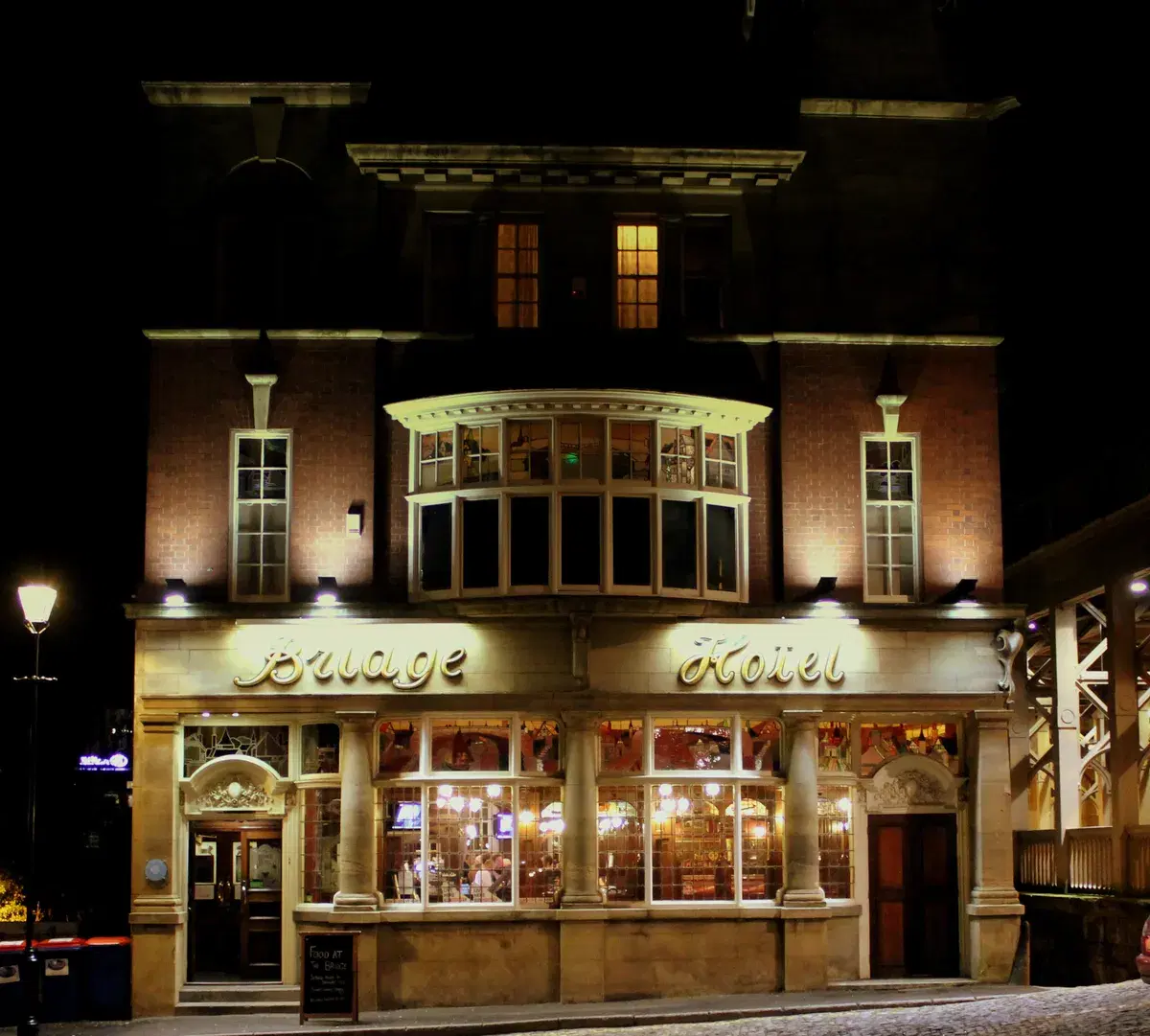
Where the city was born, on the Castle Garth beneath the medieval keep and the High Level Bridge, stands the Bridge Hotel. The current building went up around the turn of the 20th century, designed by the architects Cackett & Burns Dick, and it is Grade II listed for its cosy Victorian snugs, wooden panelling, mosaic floors and stained glass. It sits on a spot that has been at the heart of Newcastle since the Romans built the first bridge across the Tyne here, and a stretch of the town wall survives just outside. The pub is also home to the Bridge Folk Club, which has met here since the late 1950s, making it one of the longest-running folk nights in the country. The rear terrace gives one of the best pub views in the city.
Best for: Combine a drink at the Bridge Hotel with a look at Newcastle Castle next door and the surviving section of the medieval town wall.
Under the Tyne Bridge
For sheer drama of setting, few pubs match the Bridge Tavern on Akenside Hill, wedged directly beneath the great green arch of the Tyne Bridge, between two of its stanchions. There has been an ale house on or near this site for the best part of two centuries. The earlier building, once the Newcastle Arms, was demolished in the 1920s so the Tyne Bridge could be built, and the pub was rebuilt in its present form in 1925; the old Newcastle Arms name is still carved into the stone frontage. Today it brews its own beer on the premises, continuing a long Tyneside tradition in a spectacularly modern-industrial spot.
Around the Bigg Market and High Bridge
A short walk uphill, the Blackie Boy on the Groat Market carries a history stretching back over two hundred years, its name recorded in various forms since the early 19th century. In the late 1700s a debating and drinking society known as "Swarley's Club", named after a landlord, met on the site and counted the celebrated Newcastle engraver Thomas Bewick among its members. The current frontage is a later Victorian and early 20th-century rebuild, but the site's pedigree is genuine.
Cutting through to High Bridge, the narrow lane between Grey Street and Pilgrim Street, you reach two more survivors. Bacchus is a much-decorated real-ale pub whose interior nods to Tyneside's shipbuilding past, with an ocean-liner feel and walls lined with photographs of the region's industries; it has been a repeat CAMRA award winner and a regular in the Good Beer Guide. A few doors along, the Duke of Wellington is a classic small city-centre pub known for its cask ales, and it carries one of Newcastle's stranger tales: its landlord in the 1870s, William Campbell, was reputedly one of the heaviest men in Britain of his day.
Making a day of it
The good news for anyone wanting to trace the old town over a pint is that these pubs cluster tightly. The Old George, Blackie Boy, Bacchus and the Duke of Wellington are all within a few minutes of one another around the Bigg Market and High Bridge, while the Crown Posada, Bridge Hotel and Bridge Tavern sit close together down on the Quayside and Castle Garth. Monument and Central Station Metro stops put both clusters within easy reach, so a short, well-earned walk downhill from the shops to the river links most of them. Opening hours vary, especially early in the week, so it is worth a quick check before setting out.
Know a historic Newcastle pub we have missed, or spotted a detail that needs correcting? Get in touch and let us know.
Local businesses mentioned
The Old George Inn
Old George Yard, Cloth Market, Newcastle upon Tyne, NE1 1EZ
Crown Posada
31 The Side, Newcastle upon Tyne, NE1 3JE
The Bridge Hotel
Castle Garth, Newcastle upon Tyne, NE1 1RQ
The Bridge Tavern
7 Akenside Hill, Newcastle upon Tyne, NE1 3UF
Blackie Boy
11 Groat Market, Newcastle upon Tyne, NE1 1UQ
Bacchus
42-48 High Bridge, Newcastle upon Tyne, NE1 6BX
Duke of Wellington
18 High Bridge, Newcastle upon Tyne, NE1 1EN
Never miss what’s on
Join the weekly Newcastlecity.live digest — the best events, news and local tips, straight to your inbox. Free, one email a week.
What's On
Jack Rooke's Good Grief
7:30pm · Northern Stage, Newcastle
Fresh Thursday: 12V5 and Tim Shaw
7:00 PM · Cobalt Studios, 10-16 Boyd Street, Ouseburn, NE2 1AP
Ghosts of History: Halloween at Newcastle Castle
See booking · Newcastle Castle, Castle Garth, Newcastle upon Tyne, NE1 1RQ