Interesting Facts About Newcastle
The castle that named the city, the first public room lit by electric light, a fair larger than Central Park and a vampire rabbit above a cathedral door: verified facts about Newcastle upon Tyne.
Newcastle wears its history lightly, but scratch the surface and the city turns out to be responsible for a surprising number of firsts, records and curiosities. Here are some genuine facts about Newcastle upon Tyne, from the castle that gave it its name to the small stone rabbit that has puzzled passers-by for over a century.
The name and the castle
The city is named after an actual new castle. In 1080, Robert Curthose, the eldest son of William the Conqueror, raised a wooden fortification on the bluff above the Tyne on his way back from campaigning against the Scots. The settlement became known as Novum Castellum, the New Castle, and the name has stuck ever since.
That wooden castle was later rebuilt in stone. The keep that stands today at Newcastle Castle was put up for Henry II in the 1170s, and the later Black Gate barbican was added in the 13th century. The two survive as a single visitor attraction, oddly cut off from each other by the Victorian railway viaduct that was driven straight through the castle site.
The Romans got there first, though. Around AD 122 they built a bridge across the Tyne here and named it Pons Aelius, the Bridge of Aelius, after the family name of the Emperor Hadrian. A small Roman fort guarded the crossing on the ground the medieval castle would later occupy.
Roman Newcastle and the Wall
Hadrian's Wall ran through what is now Newcastle on its way east. The very end of the Wall was not in the city centre but a few miles downriver at Wallsend, the Roman fort of Segedunum, whose name gives the modern town its rather literal identity. Sections of Roman and medieval stonework still turn up across the city.
The medieval town walls came much later, built through the 13th and 14th centuries to keep out Scottish raiders. At their fullest the walls ran for roughly two miles, stood up to 25 feet high, and had six main gates. Substantial stretches survive, and the best-preserved run sits beside Chinatown off Stowell Street, one of the finest surviving town walls in England after York and Chester.
Science and firsts
Newcastle has a strong claim to lighting the modern world. On 20 October 1880, the lecture theatre of the Literary and Philosophical Society became the first public room anywhere to be lit by electric light, using the incandescent lamp developed by the Sunderland-born chemist Joseph Swan. Swan demonstrated his bulb to the Lit and Phil's members before Edison's rival work had reached the public.
The Lit and Phil itself is no ordinary library. Founded in 1793, it holds around 200,000 books and is the largest independent library outside London. Its past presidents read like a roll-call of the industrial age: Robert Stephenson, Lord Armstrong and Charles Parsons among them.
Railways were effectively industrialised here too. Robert Stephenson and Company, set up on Forth Street in 1823, was the first factory in the world built specifically to manufacture railway locomotives. The Rocket and Locomotion No. 1 were both built in Newcastle before going on to change how the world moved.
Best for: The Lit and Phil is free to visit and open to the public, not just members, so you can stand in the room where electric light first shone in public.
Bridges and engineering
The Tyne Bridge, the green steel arch that has become the city's emblem, opened in 1928. It was built by Dorman Long of Middlesbrough, the same firm that went on to build the far larger Sydney Harbour Bridge, which opened in 1932. The two bridges are often called twins; in truth the Australian arch is much bigger and was not simply copied from the Tyne, but they share the same Teesside steelmakers and a strong family resemblance.
The Tyne Bridge is one of seven bridges crossing the river between Newcastle and Gateshead within a short stretch, a cluster that has made the gorge one of the most photographed river crossings in Britain. The tilting Gateshead Millennium Bridge, which opened in 2001 and pivots like a slowly blinking eye to let boats pass, is the newest of them.
Quirks and curiosities
Tucked above a doorway on Amen Corner, behind Newcastle Cathedral, is one of the city's strangest sights: the Vampire Rabbit. This fanged black creature is a grotesque carved on the Cathedral Buildings when they were built in 1901, and it faces the back of the cathedral. Nobody is entirely sure what it is meant to be or why it is there. It is said to be either a warning to grave robbers or a playful hare with its ears mounted the wrong way; both are tradition rather than documented fact, and it has since been painted black with bloodied teeth by persons unknown.
The city also has a piece of green open space that dwarfs almost anything in London. The Town Moor, a stretch of common land just north of the centre, covers around 1,000 acres, larger than Hyde Park and Hampstead Heath combined, and bigger than New York's Central Park. The Freemen of Newcastle still hold the ancient right to graze cattle on it, and you can genuinely find cows grazing within sight of the city centre. Their numbers are capped at 800 head.
Each June the Moor hosts the Hoppings, one of the largest travelling fairs in Europe, a tradition that grew out of a temperance festival in the late 19th century intended as a sober alternative to race-week drinking.
As for the famous drink, Newcastle Brown Ale was launched in 1927 after three years of development by Colonel James Porter at Newcastle Breweries. It became such a local institution that its blue-star logo is still worn with pride, even though production long ago left the city.
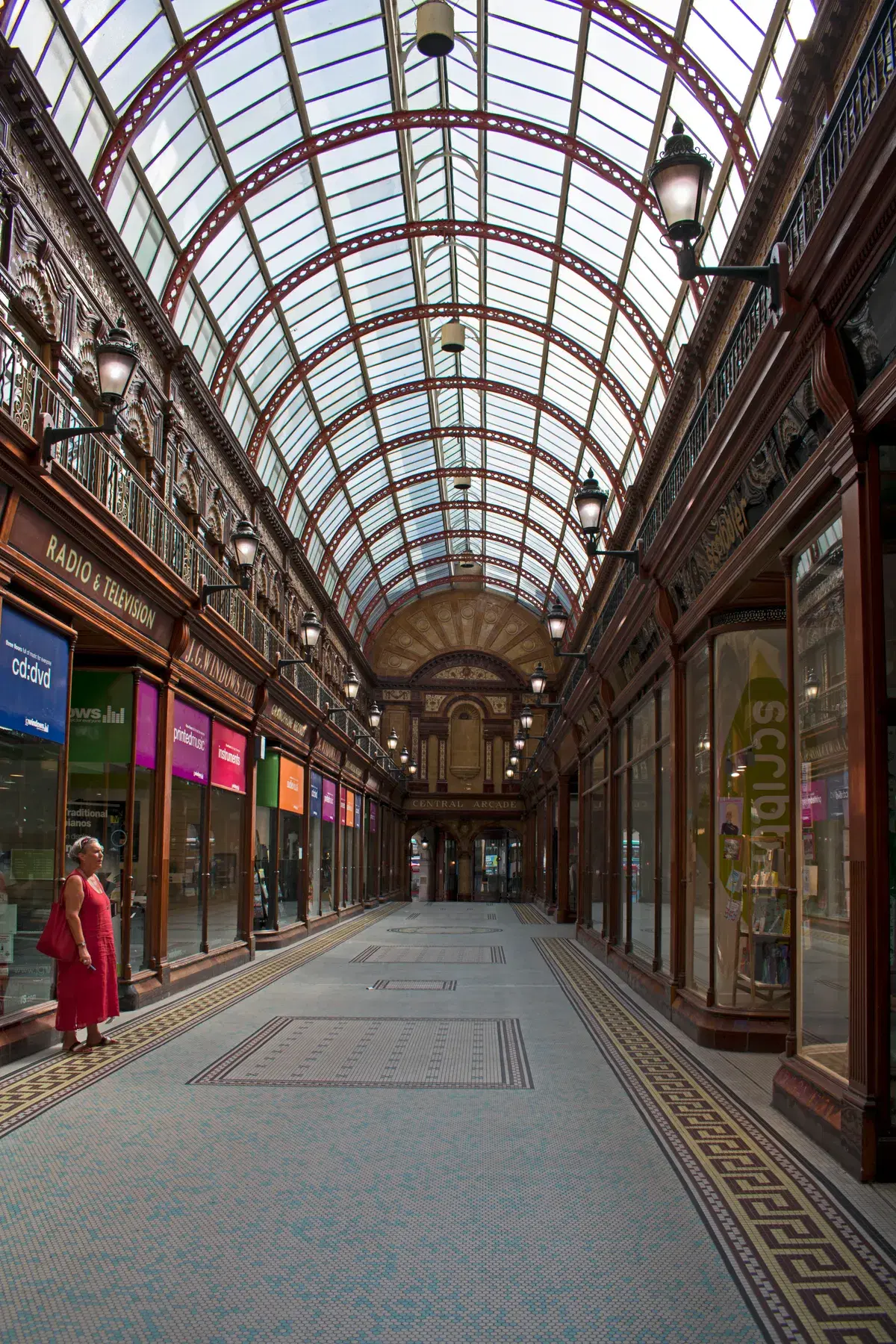
Best for: For Edwardian splendour, step into the Central Arcade off Grainger Street: built in 1906 inside an older Grainger building, its barrel-vaulted glass roof and richly coloured faience tiles make it one of the most beautiful shopping arcades in the country.
Grainger Town and the planned city
Much of the elegant centre you walk through was built in barely a decade. In the 1830s the developer Richard Grainger, working with architects including John Dobson, rebuilt the heart of the town in honey-coloured stone, creating Grey Street, Grainger Street and the Grainger Market. Grey Street in particular is regularly voted one of the finest streets in England for its sweeping classical curve.
Presiding over it all is Grey's Monument, raised in 1838 to Charles, 2nd Earl Grey, the Prime Minister who carried the Great Reform Act of 1832 through Parliament. The column stands 133 feet tall, and if you are lucky enough to catch one of the occasional open days you can climb the internal stairs for a view down Grey Street. The tea, incidentally, is named after the same man.
Know a Newcastle fact we have missed, or spotted a detail that needs correcting? Get in touch and let us know.
Local businesses mentioned
Newcastle Castle
The Black Gate, Castle Garth, Newcastle upon Tyne, NE1 1RQ
Newcastle Cathedral
Cathedral Church of St Nicholas, St Nicholas Square, Newcastle upon Tyne, NE1 1PF
Newcastle Town Walls
Town Walls, Bath Lane and Stowell Street, Newcastle upon Tyne, NE1 4XN
Literary & Philosophical Society
23 Westgate Road, Newcastle upon Tyne, NE1 1SE
Central Arcade
Central Arcade, Grainger Street, Newcastle upon Tyne, NE1 6EG
Newcastle Quayside
Quayside, Newcastle upon Tyne, NE1 3 (riverside from the Tyne Bridge east towards Ouseburn)
Grainger Market
Grainger Market, Grainger Street, Newcastle upon Tyne, NE1 5QQ
Never miss what’s on
Join the weekly Newcastlecity.live digest — the best events, news and local tips, straight to your inbox. Free, one email a week.
What's On
Jack Rooke's Good Grief
7:30pm · Northern Stage, Newcastle
Fresh Thursday: 12V5 and Tim Shaw
7:00 PM · Cobalt Studios, 10-16 Boyd Street, Ouseburn, NE2 1AP
Ghosts of History: Halloween at Newcastle Castle
See booking · Newcastle Castle, Castle Garth, Newcastle upon Tyne, NE1 1RQ