A History of Newcastle's High Street
How Newcastle's principal shopping streets grew from a Georgian turnpike into Grainger Town's grand terraces, and how the retail heart shifted over two centuries.
Newcastle does not really have a single "high street" in the way a small market town does. Instead it has a cluster of famous shopping streets, each from a different era: the long pull of Northumberland Street, the curving grandeur of Grey Street, and the sturdy Victorian aisles of the market halls. Piece them together and you get two hundred years of retail history written into the stone.
The old road north
Northumberland Street was, for centuries, simply the main road out of town. It formed part of the Great North Road, the coaching route between London and Edinburgh, climbing up from Pilgrim Street and heading on towards the border. Traffic, inns and trade naturally clustered along it, and by the nineteenth century it was establishing itself as Newcastle's busiest shopping thoroughfare.
For most of its life the street carried vehicles as well as shoppers. It was progressively closed to traffic through the later twentieth century, and the final northerly stretch beyond Northumberland Road, long a busy bus route, was pedestrianised in 1999. Today it is one of the busiest shopping streets in the country, but its dead-straight run still betrays its origins as a turnpike road.
Richard Grainger rebuilds the town
The single most dramatic chapter came in the 1830s. The builder and developer Richard Grainger, backed by borrowed capital and working with the architect John Dobson and others, swept away the old mansion and gardens of Anderson Place and laid out a whole new commercial quarter in Tyneside sandstone. The area is now known, appropriately, as Grainger Town.
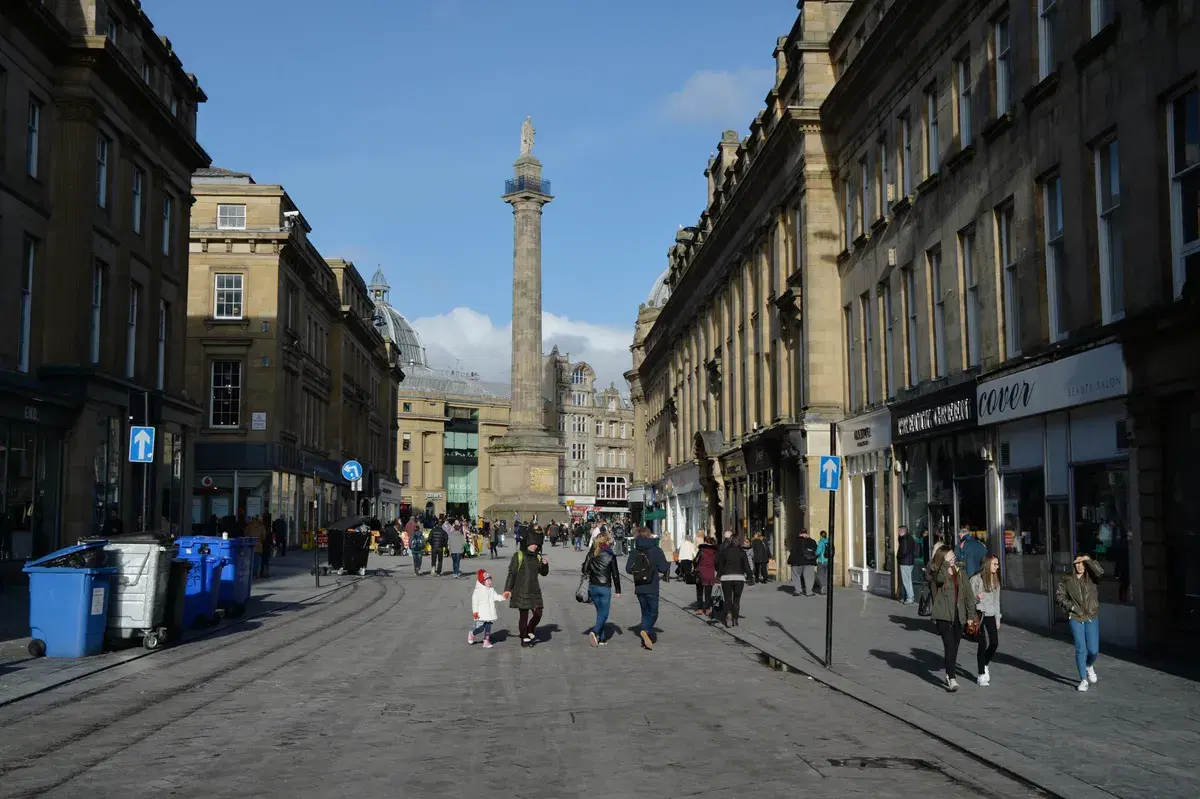
The showpiece was Grey Street, completed in 1837 and curving gracefully downhill towards the river. It is often described as one of the finest streets in England, praised for the way its unbroken classical facades follow the bend of the land. Dobson is frequently credited with the whole design, but in truth he drew only the south-eastern side; the western side was the work of the architects John Wardle and George Walker, who worked in Grainger's own office. Grainger Street was cut alongside it, and together they gave the city a spacious, ordered centre very different from the cramped medieval Quayside below.
Best for: Grey Street's sweeping classical curve is admired partly because its terraces were designed as a single composition, following the slope of the old Lort Burn valley.
The market halls
At the heart of the scheme sat the Grainger Market, opened in 1835 and built to replace the older markets displaced by the redevelopment. Its long iron-and-glass aisles have sheltered butchers, grocers, fishmongers and greengrocers ever since, making it one of the oldest covered markets of its kind still trading in Britain.
The market has one small claim that draws visitors from far beyond Tyneside. Michael Marks, who had opened his first Penny Bazaar stall in Leeds in 1884, established a stall in the Grainger Market in 1895. That stall survives, complete with its cherry-red and gold period signage, and is generally described as the last of the original Penny Bazaars, the humble stalls from which the whole Marks and Spencer chain grew.
A short walk away, the elegant Central Arcade offers a very different shopping experience. The arcade was created inside the older Central Exchange building and reopened in 1906, lined with glazed faience tiling and lit from a glass roof. It remains one of the most photographed interiors in the city, an Edwardian shopping mall that has outlived most of its contemporaries.
The rise of the department store
While Grainger was reshaping the streets, a new kind of shop was appearing. In 1838 Emerson Muschamp Bainbridge opened a drapery on Market Street. By 1849 he was recording weekly takings separately for each of his twenty-three departments, and it is on that basis that Bainbridge's is often cited as one of the world's first true department stores. The firm grew enormously over the following decades, and in time passed to John Lewis, which eventually gave the Newcastle store the John Lewis name.
The city's other retail giant began more modestly. John James Fenwick, a draper originally from Richmond in North Yorkshire, opened a shop on Northumberland Street in 1882 selling mantles, silks and dresses. It broadened into a full department store after his son Fred, who had trained in Paris and admired the great Parisian stores, joined the business around 1890. Fenwick has stayed in family hands and remains anchored to Northumberland Street, with entrances now reaching through to Eldon Square and Blackett Street.
Best for: Both of Newcastle's landmark department store names, Bainbridge's and Fenwick, were founded in the nineteenth century, within a few streets of one another.
Monument, chambers and the modern centre
The junction where Grey Street, Grainger Street and Blackett Street meet is dominated by Grey's Monument, the tall column raised in honour of Earl Grey in 1838. It has become the natural meeting point of the city and lends its name to the surrounding retail district. Nearby on Blackett Street stands Emerson Chambers, a flamboyant building of around 1903 in an Art Nouveau and Baroque style, built as a restaurant and offices and now occupied by Waterstones. Its copper domes and turret clock make it one of the most distinctive shopfronts in the centre.
The biggest shift of all came in 1976, when the Eldon Square shopping centre opened just off Northumberland Street. It pulled a great deal of retail indoors and into one enclosed space, changing the way people moved around the city and reinforcing the Monument area as the commercial core while the old Quayside trade continued its long retreat.
Today the story is still being written. Some grand old names have gone, new ones have arrived, and the balance between covered malls, historic arcades and the open street keeps shifting. But the bones remain remarkably intact: Grainger's terraces, the market halls, the arcade, and the long straight line of the old road north.
Best for: The surviving concentration of Georgian and Edwardian commercial architecture is why much of central Newcastle is protected as a conservation area.
If you want to see this history laid out in stone, walk from Grey's Monument down Grey Street, cut through to the Grainger Market and the Central Arcade, and you will cross nearly two centuries of the city's shopping story in ten minutes.
Spotted something we have got wrong, or remember a shop that should be here? Get in touch.
Never miss what’s on
Join the weekly Newcastlecity.live digest — the best events, news and local tips, straight to your inbox. Free, one email a week.
What's On
Jack Rooke's Good Grief
7:30pm · Northern Stage, Newcastle
Fresh Thursday: 12V5 and Tim Shaw
7:00 PM · Cobalt Studios, 10-16 Boyd Street, Ouseburn, NE2 1AP
Ghosts of History: Halloween at Newcastle Castle
See booking · Newcastle Castle, Castle Garth, Newcastle upon Tyne, NE1 1RQ