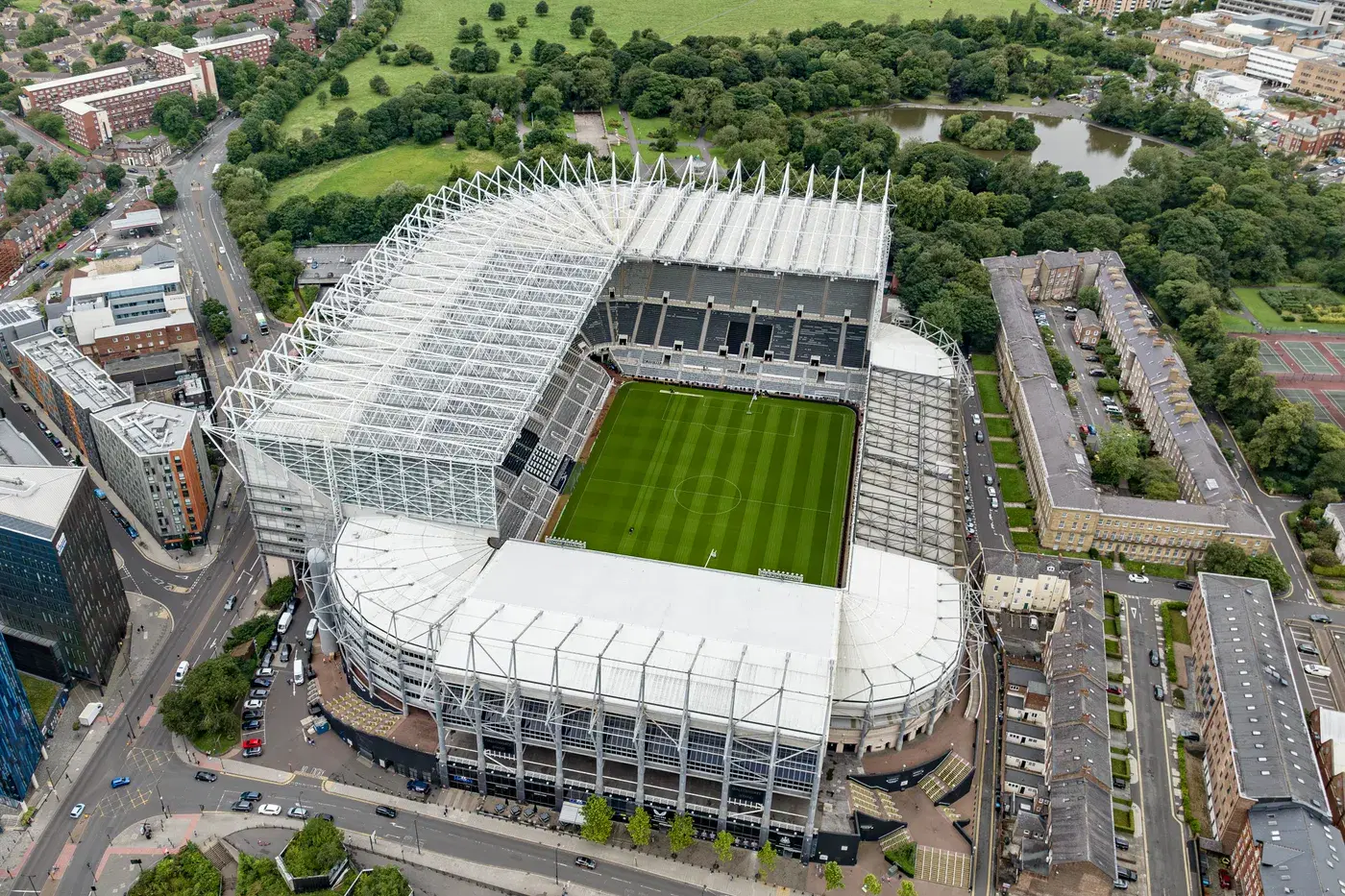
Sport and Fitness in Newcastle City Centre
Newcastle keeps its football ground, its half marathon start line and a thousand acres of common land within walking distance of the shops. A guide to St James' Park, the Great North Run, city-centre pools and the best routes out of the middle of town on foot or by bike.
Most cities push their sport to the ring road. Newcastle does the opposite. The football ground is four minutes from the main shopping street, the start line of the world's biggest half marathon is at the top of the central motorway, and a thousand acres of grazed common land begins where the built centre stops. You can be on grass, in a pool or on a riverside path inside ten minutes of Grey's Monument, which is unusual for a city of this size. Here is how to use it.
St James' Park
St James' Park is the largest thing on the city centre skyline, and it is genuinely in the centre rather than near it. Football has been played on the site since 1880, when Newcastle Rangers used the ground, and Newcastle United have been here since 1892, following the merger of two rival local clubs. Successive rebuilding through the 1990s and into the early 2000s took the capacity to just over 52,000, making it one of the largest club grounds in England.
The shape tells you about the constraints. Building room on the Leazes side was limited, so the stadium ended up deliberately asymmetrical, with two very tall stands and two much lower ones, and the steel truss cantilever roof over the Milburn and Leazes complex spans 64.5 metres. The pitch is laid out to maximum international dimensions. The ground has hosted far more than league football over the years, including England internationals, matches in the 2015 Rugby World Cup, football at the 2012 Olympic Games and large outdoor concerts.
Three statues are worth finding even if you are not going in. The Sir Bobby Robson statue stands at the Gallowgate corner, a bronze by Tom Maley unveiled in May 2012. The Alan Shearer statue originally stood out on Barrack Road, outside club land, and was moved in 2022 to the foot of the Gallowgate West entrance steps beside Robson. Jackie Milburn stands on Strawberry Place, near the official club store.
Best for: St James is the nearest Metro station and sits directly beneath the ground, with Monument and Haymarket both a short walk.
Stadium tours
Newcastle United run public tours of the ground, bookable through the club's website. The standard option is the Classic Tour, which goes behind the stands to the players' tunnel and the home dressing room, and into the media suite used for post-match press conferences. The club also runs matchday tours and, in summer, rooftop tours.
This is the best way to see the interior if you cannot get a ticket, and it works well for visitors who want the view over the city from height without paying for a matchday. Availability moves with the fixture list and with events in the stadium, so check before travelling rather than turning up.
Best for: Book ahead; tour dates are pulled when the ground is in use for fixtures or concerts.
Matchday in the city centre
Because the ground sits inside the street grid, a home fixture visibly takes over the middle of Newcastle rather than filling a car park somewhere else. The effect radiates out from Gallowgate and Strawberry Place through the Bigg Market and Newgate Street, and the pubs and bars on the western edge of the centre fill from late morning.
The practical consequences are worth knowing. Roads around Barrack Road, Gallowgate and Strawberry Place are managed differently on matchdays, the Metro is busy in both directions either side of kick-off, and city-centre restaurant tables book out earlier than usual. If you are visiting Newcastle for something other than football and there is a home game, plan to eat early or late.
Best for: Check the fixture list before booking a city-centre restaurant table on a Saturday.
The Great North Run
The Great North Run is the largest half marathon in the world, and it starts in Newcastle. It was devised by Brendan Foster, the former Olympic 10,000 metres bronze medallist and BBC commentator, and first staged in 1981. It now runs in September.
The start line is on the A167 at Claremont Road, at the top of the central motorway on the northern edge of the city centre, with Haymarket the nearest Metro station. From there the field drops south, crosses the Tyne Bridge into Gateshead, and runs the 13.1 miles east to finish on the Coast Road at South Shields. A Red Arrows flypast has become one of the event's fixtures, although the team does not appear every year. Entry to the mass race is by ballot, with charity places available in exchange for a fundraising commitment.
The weekend is bigger than the Sunday race. The Great North 5k runs on the Friday, starting on the Newcastle Quayside and taking in the Swing Bridge, the Millennium Bridge and the Ouseburn. The Junior and Mini Great North Run follow on the Saturday, also on the Quayside, with a shorter distance for younger children and a longer one for older ones.
Best for: If you are not running, the Quayside events on the Friday and Saturday are the easiest ones to watch on foot.
Running and walking the Quayside
The riverside promenade below the bridges is the obvious run from the centre, and it is flat, paved and well lit for much of its length. Heading east from the Tyne Bridge takes you past the Millennium Bridge and down towards the mouth of the Ouseburn; heading west takes you along The Close beneath the Castle Keep.
Two things are worth understanding before you plan a long one. First, the signed long-distance route through Newcastle is the Hadrian's Wall Path, the National Trail that runs 84 miles from Segedunum at Wallsend to Bowness-on-Solway, and it is routed along the Newcastle Quayside. You can pick it up at the bridges and follow it in either direction without any navigation. Second, the riverside is not continuous. Both east and west, the signed route leaves the water at points and takes to inland streets and old railway alignments, so an out-and-back on the promenade itself is a shorter run than the map suggests.
The Gateshead bank gives you the other half of the picture, and the Millennium Bridge is reserved for pedestrians and cyclists, so a loop over one bridge and back across another is the standard city-centre circuit.
Best for: A bridge-to-bridge loop using the Millennium and Swing bridges is the simplest measured run from the Quayside.
Leazes Park
Leazes Park sits immediately behind St James' Park, bounded by Barrack Road to the south, with an entrance on Richardson Road opposite the Royal Victoria Infirmary. It opened on 23 December 1873 as the first purpose-built public park in Newcastle, and it is a Grade II registered park and garden. The layout is still legible: a lake with an island at the centre, and a perimeter walk running through a ring of woodland planting.
For anyone staying or working in the centre, this is the nearest thing to a proper park circuit, and the tree cover makes it a better wet-weather run than the open moor to the north. Leazes parkrun takes place here on Saturday mornings at nine, three anticlockwise laps on tarmac, with runners gathering at the bandstand. It is free, timed and open to anyone registered with parkrun.
Best for: Leazes parkrun, Saturdays at 9am, three laps on tarmac. Register once online and the barcode works anywhere.
Exhibition Park and the Town Moor
Exhibition Park, bordered by the Great North Road and Claremont Road, is the gateway to the open ground north of the centre. It is the surviving fragment of the North East Coast Exhibition of Industry, Science and Art, held here from May to October 1929 and opened by the Prince of Wales. The Palace of Arts is the only 1929 building left standing, Grade II listed and now occupied by Wylam Brewery; the Grade II bandstand is older still, dating from 1875. There is a lake, long since given over to wildlife and model boats rather than hire craft.
Beyond it is the Town Moor, the complex of common land that includes Nuns Moor, Dukes Moor, Little Moor, Hunters Moor and Castle Leazes, and which runs to roughly 400 hectares or a thousand acres in total. That makes it larger than New York's Central Park and more than double the size of Hyde Park. Freemen of Newcastle hold grazing rights here, the city council owns the freehold, and cattle still graze in the warmer months under a limit set by the Stewards Committee. The arrangement is set out in the Town Moor Act of 1774 and renewed by the Newcastle-upon-Tyne Town Moor Act 1988, which also enshrines the public right to take air and exercise on the land.
In practice you get an enormous, unfenced, largely flat expanse of grass and gravel track a few minutes from the university campuses. Town Moor parkrun runs on Saturday mornings at nine, a single 5 kilometre loop on gravel and tarmac, starting just outside the northern boundary of Exhibition Park behind the brewery. There is also a Town Moor junior parkrun on Sunday mornings, two kilometres, for children aged four to fourteen.
Best for: Cattle graze the Moor in season, so keep dogs under control and expect gates and grids on the paths.
Swimming and city-centre leisure
The city centre's public pool is the City Baths on Northumberland Road, a Grade II listed building that opened in November 1928. It closed in 2013 as a cost-cutting measure, was restored at a cost of around £7.5 million, and reopened to swimmers and gym users in January 2020. The restored Turkish Baths, with their glass dome, reopened in April 2024 and are the most unusual thing of their kind in the region. The site is currently operated on the council's behalf by Better, which took over in July 2026, and alongside the pool there is a gym, fitness studios, a sauna and the spa.
Eldon Leisure, in Eldon Square, is the other name people still ask about. It has been closed since 2020 and has not reopened; its former home forms part of a large approved redevelopment of that end of the shopping centre into a family leisure and entertainment attraction. If you are looking for a sports hall, squash court or indoor climbing wall in the centre, that provision went with it, and the university sites below are now the main option.
Beyond the council estate, the centre is well supplied with private gyms and studios across the usual range from budget chains to boutique class operators, concentrated around Grainger Town, Pilgrim Street and the Quayside. Membership terms and opening hours change often enough that it is worth checking directly rather than relying on a list.
Best for: The Turkish Baths at the City Baths are bookable separately from ordinary pool and gym use.
Cycling from the centre
The Quayside is the natural way out of the city on two wheels. National Cycle Network Route 72, the Hadrian's Cycleway, follows the north bank of the Tyne through Newcastle and along the Quayside, running 170 miles in total between Ravenglass in Cumbria and South Shields. Be realistic about the surface: the route as a whole is only around a third traffic-free, and the Quayside stretch is shared-use promenade rather than a segregated lane, so it gets busy with pedestrians at weekends and on event days.
On the Gateshead side, Route 141, the Keelman's Way, runs along the south bank between roughly Wylam and Bill Quay and is far more sheltered from traffic, at better than four-fifths traffic-free. Crossing between the two banks on the Millennium Bridge, which carries only pedestrians and cyclists, gives you a long, largely flat riverside loop that starts and ends in the middle of the city.
One practical note: there is no public bike-share or e-scooter hire scheme running in Newcastle at the moment. The rental e-scooter operator that served the city withdrew in 2026 and nothing has replaced it, so hire means an independent bike shop rather than an app.
Best for: Riverside routes are shared with walkers rather than segregated. Use a bell and expect to slow down on the Quayside.
University sport
Both universities sit inside or on the edge of the city centre, and one of them is a genuine public option. Northumbria's Sport Central is on Northumberland Road, the same street as the City Baths, and holds a 25 metre six-lane pool, a gym, a main arena and sports hall, badminton courts, a climbing wall and a large weekly class programme. Membership is open to students, staff, alumni and the general public, with a community tier for local residents, and pay-as-you-go swimming is available. For a city-centre resident without a car, it is the most complete facility within walking distance.
Newcastle University's Sport and Fitness Centre, off Wallace Street near the Claremont Road approaches, is the larger of the two in gym terms, with a big open-plan fitness floor, studios, squash courts and a sports hall. Access is more restricted: membership is limited to students, staff and a defined associate category covering graduates, retired staff, staff family, public sector employees and residents living within a quarter of a mile of the building. It is worth checking your eligibility before assuming you can join.
Both universities also run outdoor grounds away from the centre, on the eastern and northern edges of the city, which is where most competitive club fixtures in football, rugby and lacrosse are actually played.
Best for: Sport Central takes public and community memberships; the Newcastle University centre generally does not.
Run a club, class or session in the city centre we should know about? Get in touch via our contact page.
Local businesses mentioned
Never miss what’s on
Join the weekly Newcastlecity.live digest — the best events, news and local tips, straight to your inbox. Free, one email a week.
What's On
John Pope Quintet + Urvashi
7:30 PM · The Cumberland Arms, James Place Street, Ouseburn, Newcastle upon Tyne, NE6 1LD
Mathew Jonson (Live) and Cousin Dan
11:00 PM · Cobalt Studios, 10-16 Boyd Street, Ouseburn, NE2 1AP
Comic Con at Utilita Arena
9:00 AM - 6:00 PM · Utilita Arena, Arena Way, Newcastle, NE4 7NA