Historic Churches and Places of Worship in Newcastle City Centre
Newcastle has two cathedrals within ten minutes of each other, three medieval parish churches, an oval Georgian church above the Quayside and the cloister of a Dominican friary. A guide to the city centre's places of worship, and the honest truth about their opening hours.
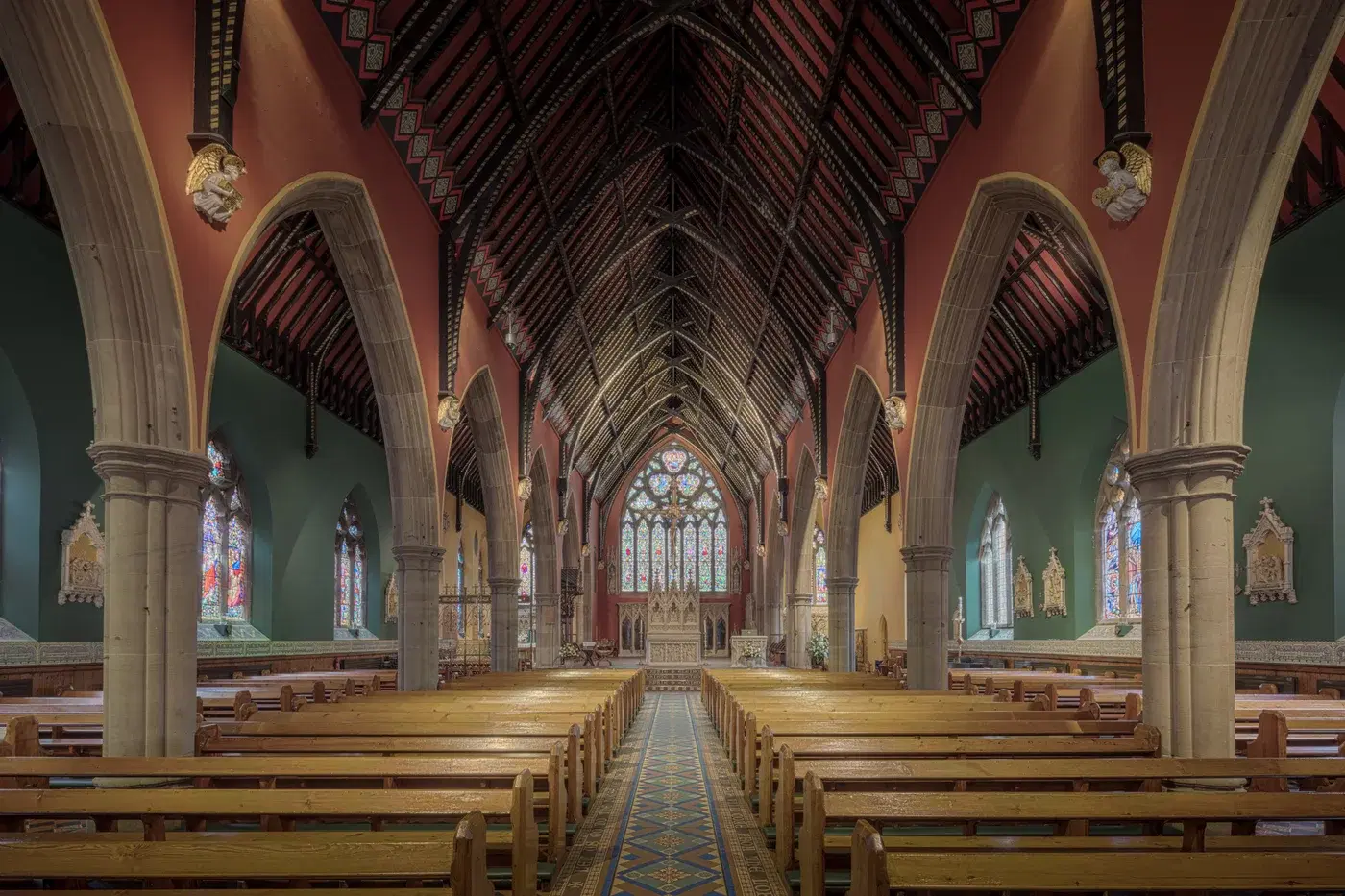
Newcastle city centre holds a remarkable concentration of listed places of worship, and most people walking between Monument and Central Station pass four of them without looking up. There are two cathedrals here, Anglican and Roman Catholic, about ten minutes apart on foot. There are three medieval parish churches, one of them with a Norman arch and another with 14th-century glass showing the city's own coat of arms. There is a Georgian church above the Quayside built on an oval plan. And there is the cloister of a Dominican friary that survived the Reformation because the town's craft guilds moved in.
This guide covers what is actually worth going inside for, and it is honest about the one thing every other guide glosses over: opening hours in this group are unreliable, frequently unpublished, and in one case do not exist in any form at all. Where that is true, we say so rather than printing a time we cannot stand behind.
Newcastle Cathedral, St Nicholas Square
Newcastle Cathedral is the Cathedral Church of St Nicholas, and it did not become a cathedral until 1882. Until then it was the town's principal parish church, which is why the inside reads nothing like a monastic cathedral: it is a very large medieval parish church, its floors and walls crowded with monuments and ledger stones, its origins in the early 12th century and its major expansion in the 14th.
The thing that makes it a landmark is the 15th-century lantern tower, a crown spire carried on flying buttresses. It worked as a navigation light for shipping coming up the Tyne, and from the Quayside it is still the shape that fixes where the old town centre is. Inside, the single object most worth seeking out is the brass of Roger Thornton, the merchant who dominated the town's fortunes in the early 15th century. It is not originally from here; it was moved across from the medieval All Hallows church before that building was demolished in the 1780s.
One practical warning that matters more than most. The main step-free West Entrance is closed at the time of writing while work continues on the Lantern Tower, and the East Entrance is the only level way in. Note also that the cathedral's own guidance and the Newcastle Cathedral Trust have said different things about whether it is open daily or by appointment, so check the cathedral's website before making a special trip.
Best for: The city's medieval heart, and the best free hour in Newcastle when it is open.
St Mary's Cathedral, Clayton Street West
St Mary's Cathedral is the Roman Catholic cathedral of the Diocese of Hexham and Newcastle, listed Grade I, and Historic England describes it as a major composition by Augustus Welby Northmore Pugin. It opened in August 1844 as a large parish church and was raised to cathedral status in 1850, when the Catholic hierarchy was restored. That makes it the older cathedral of the two by some distance, a fact that catches almost everyone out.
The spire that makes it visible from half the city is not Pugin's. He designed a tower and spire, the money did not stretch, and the upper stages of the tower and the spire were added in 1872 to designs by Dunn and Hansom, paid for by a bequest from Elizabeth Dunn. Historic England's description of the belfry, with its crocketed dripmould and what the entry calls fantastic beast finials, is worth reading before you look up.
The interior repays a slow circuit rather than a quick look. The great east window is a Tree of Jesse, showing the kings and prophets of the Old Testament. The bishop's chair was carved by Ralph Hedley, the Tyneside painter and craftsman. One window near the west end shows the church itself being built. A window by Cate Watkinson, unveiled in 2004, commemorates Adam Wakenshaw, the Newcastle-born VC who died in 1942, and several of the modern windows replace glass blown out by wartime bombing on the south side of the building.
Outside is the Cardinal Basil Hume Memorial Garden, with a bronze of the Newcastle-born cardinal by Nigel Boonham, opened by the Queen in 2002. Entry is free. It stands directly opposite Central Station, which makes it the easiest of all of these to fit around a train.
Best for: Pugin, a Tree of Jesse window and a garden, thirty seconds from the station concourse.
St Andrew's, Newgate Street
St Andrew's is traditionally called the oldest church in Newcastle. That is a tradition rather than a finding, and it is worth knowing the difference. Historic England records 12th-century work in the chancel arch, the lower tower and the arcades. An archaeological assessment commissioned by the Diocese of Newcastle in 2018 puts it more carefully: substantially the earliest of the city's three old parish churches.
What you come for is the Norman chancel arch, dated in that assessment to about 1150, carrying zig-zag moulding in two orders above nave arcades of round piers with octagonal capitals. Then there is a proper surprise: the south porch was refronted in 1726 with channelled rustication, a cornice and a segmental pediment, a full classical frontispiece bolted onto a medieval church. John Dobson rebuilt the south transept in 1844.
Look down as well as up. Medieval cross-slab grave covers are set into the floors, one in the chancel carved with a hammer and three horseshoes. Outside, the churchyard's northern boundary is the 14th-century town wall, which the church predates by two centuries. It is an active parish church with a workplace chaplaincy and is home to the Northumbria Deaf Mission. Published opening hours vary between sources and depend on volunteers, so ring ahead.
Best for: A Norman arch and a Georgian porch on the same building, two minutes from Eldon Square.
St John the Baptist, Grainger Street
St John the Baptist sits on the corner of Grainger Street and Westgate Road, mostly 14th and 15th century, with a chancel largely rebuilt in 1848. Its statutory heritage address is Westgate Road while the parish, the diocese and the National Churches Trust all give Grainger Street, so if a map sends you to the wrong side of the building that is why.
The reason to go in is the medieval stained glass, and the listing does not mention it at all. A north chancel window of 1375 to 1400 carries the oldest known depiction of Newcastle's coat of arms, the three silver castles on a red shield. A second window of about 1381, in the Blessed Sacrament Chapel, marks the marriage of Henry Percy, first Earl of Northumberland, to Maude Lucy, showing the Percy lion alongside the Lucy pikes. For a city that sells its castles hard, the oldest surviving picture of them being in a window on Grainger Street is a good piece of trivia.
There are also heraldic shields running along the hood-mould of the north arcade, a 17th-century octagonal font with a cover in 15th-century style, and the upper part of a small round-headed Norman window surviving in the north chancel wall. Thomas Bewick, the engraver, was married here in 1786. The churchyard is one of very few patches of green in this part of town.
The congregation worships in the Anglo-Catholic tradition. Opening has been restricted in recent years and sources disagree about the current pattern, so check the church's A Church Near You listing rather than older published hours. The parish website was returning a server error when we checked in September 2026.
Best for: Newcastle's oldest picture of its own coat of arms, in 14th-century glass.
All Saints, Akenside Hill
All Saints was built between 1786 and 1796 to designs by David Stephenson, replacing the medieval church of All Hallows, and it is the most architecturally unusual building in this guide. Historic England calls its plan a rare oval design. The Tyne and Wear Building Preservation Trust goes further and describes it as the only elliptical church building in England.
Inside, the galleried interior is almost entirely mahogany, panelled pews meeting fluted Doric columns that carry the balcony, under a moulded plaster ceiling heavy with leaf and flower ornament. Outside, a Greek Doric portico is reached up three flights of steps, and the baroque tower and spire are a fixture of the skyline above the Quayside. A marble plaque in the tower vestibule commemorates Stephenson himself, who died in 1819.
One thing to know before you go, because guidebooks still get it wrong. The famous medieval font is not here. The original was rescued from the medieval church and is now at Kirkharle in Northumberland; what stands in the vestibule is a replica. The Roger Thornton brass, once over his tomb in the medieval church, is in Newcastle Cathedral.
The building closed in 1959 and spent decades in other uses and then empty, joining the Heritage at Risk Register in 2012 before a Historic England grant of £135,000 in 2019. It is a working church again: All Saints Presbyterian Church took a 150-year lease from the city council in 2019 and worship resumed that October. Descriptions of it as an urban studies centre or a concert hall are decades out of date, including in some official records.
For visitors this is the best-organised building in the guide. Self-guided tours run every Thursday from 1pm to 4pm, no booking needed. The portico is up steps, but there is a separate step-free entrance.
Best for: The one to plan a Thursday afternoon around, and the only oval church you will find in England.
St Thomas the Martyr, Haymarket
St Thomas the Martyr was built to John Dobson's designs and finished in 1830. It is a parish church with no parish, which is the interesting part. It was put up not by a parish but by the trustees of the St Mary Magdalene and Holy Jesus Hospitals, to replace a medieval chapel that stood at the north end of the old Tyne Bridge, and that origin is why it never acquired a parish of its own, why it is described as extra-parochial, and why its senior cleric is styled the Master rather than the Vicar. The medieval hospital, per a charter of James I in 1611, had the bridge chapel annexed to it, and the title has simply carried down.
Two things about that lost chapel are routinely got wrong. The bridge in question is the medieval Tyne Bridge, which stood where the Swing Bridge is now, not the 1928 arch. And the popular story that it was founded by one of Thomas Becket's assassins, or in expiation for his murder, is tradition, not record; the antiquarian Mackenzie, writing in 1827, was blunt that no records of the foundation exist.
Inside are ribbed cross vaults carried on slender quatrefoil piers, an unusually thoroughgoing stone-vaulted interior for an 1820s town church, with galleries on three sides added in 1837 and east glass of 1881. There is a memorial to Robert Wasney, who died in 1836, by C. Tate. Pair that with the church's own record of a congregation of about 2,400 by 1851 and you understand why the galleries were needed. The battle honours of the 6th Northumberland Fusiliers are here, along with a window commemorating the 43rd/49th Royal Tank Regiment.
The building has changed more in the last few years than at any point in living memory. A reordering by Doonan Architects between 2020 and 2023 added a sunken baptistery as a focal point, introduced structural glass to create acoustically separate spaces within the church, replaced steel gallery beams with glulam, and swapped crude timber panelling across the lancet windows for glass balustrades. It took a high commendation in the conservation and regeneration category at the 2023 Constructing Excellence North East awards. Because all of this post-dates the listing's most recent amendment in 1998, the official description of the interior no longer matches what you will find, and older accounts of which aisle a memorial sits in should be treated as approximate.
In the public gardens beside the church stands The Response 1914, Sir William Goscombe John's memorial to the Northumberland Fusiliers, unveiled on 5 July 1923. It is listed separately and it is listed Grade I, a higher grade than the church itself, which is Grade II*. A surprising number of write-ups transfer that Grade I to the church.
On practicalities, be warned. The church is open on weekdays for prayer but publishes no opening hours anywhere, and A Church Near You states plainly that it was unable to obtain them. Tommy's Coffee operates at the entrance and its hours are the only concrete times available, which makes them a hint that someone is on site and nothing more. Service times of 10.30am and 6.30pm still circulate in third-party listings and are pre-2019. On access the church is unusually forthcoming: it states that the main church space is level access and reachable by wheelchair, with accessible toilets and a lift to the conference room, and it offers ear defenders and movement breaks. It is directly opposite Haymarket Metro.
Best for: A Dobson church with no parish, a Master instead of a vicar, and a Grade I war memorial in the garden.
Blackfriars, Friars Street
Blackfriars needs framing carefully, because it is in this guide for what it was rather than what it is. This was the Dominican friary of Newcastle, and nothing here has been a place of worship since 1539. What survives is secular: a restaurant, event space and units around a cloister, in council ownership.
Say plainly what does not survive. The friary church exists, in the words of the official record, only as foundations. Visitors arrive expecting a medieval church and find a courtyard of guild halls. The ranges standing around the cloister are the friars' domestic and communal buildings, and much of what reads as medieval is in fact Georgian guild rebuilding on medieval footings: the Butchers' range in 1739, the Tailors' in 1787, the Cordwainers' in 1843 by John Wardle, with the whole complex restored between 1978 and 1981.
The dating is genuinely contested and we will not pretend otherwise. Newcastle's Historic Environment Record says carefully that the first reference to the friary dates from 1239, which is a first mention rather than a foundation. Brand, writing in 1789, has it founded by Sir Peter Scot and his son Sir Nicholas Scot about the year 1260. Both positions stand.
Three things are worth finding. In the west range there is a large trefoil-shaped lavatorium, the friars' washing place, and it is the single most unusual survival on the site and the thing most people walk straight past. There are corbels at cloister roof level, the physical evidence of the vanished covered walk. And fixed to the Chapter House wall is a 15th-century grave slab with the matrix of a brass, taken from the friary church, which makes it the best surviving relic of the lost building.
Why did it survive when every other Newcastle friary went? Because of what happened next. The friary was surrendered on 10 June 1539 by the prior and twelve friars, at an annual value of £2 19s 4d, granted to the town in 1544, and demised in 1552 to nine of the town's craft guilds. Four centuries of continuous secular use is the reason there is anything to look at.
If you are already here, the town wall is two minutes away. The friars were licensed in 1280 to make their own postern through it, and the adjacent scheduled stretch covers 214 metres of wall with three towers, the friars' postern itself and a ditch of about 1312.
Best for: A medieval cloister that survived because the butchers and tailors moved in.
Three more worth the detour
St James's United Reformed Church on Northumberland Road, built 1882 to 1884 by T. Lewis Banks, is the most surprising interior of any city-centre place of worship outside the two cathedrals and the least known. The octagonal spire is the signal from the street, but behind it sits a slate-hung central lantern over a glass roof carried on pendentives, closer to a domed civic hall than to a conventional nave and aisles. No routine visitor hours are published, so catch it at a service, a concert or on a Heritage Open Days weekend.
Brunswick Methodist Church stands in a courtyard off Northumberland Street, which is why thousands of shoppers pass the end of Brunswick Place without noticing it. It opened in February 1821 at a cost of £6,726 and the main worship space is on the first floor, so the ground floor reads as halls rather than a chapel. Brunswick replaced John Wesley's Orphan House on Northumberland Street, Methodism's base in the North East, and it holds exhibits from that building. Wesley himself never preached here, having died thirty years before it opened, whatever you may read elsewhere.
St Dominic's on New Bridge Street, built 1869 to 1873 by A. M. Dunn and opened by Cardinal Manning, is aligned north to south rather than east to west, which you can check from the door. Inside are choir stalls of 1826 brought here from Peterborough Cathedral, an alabaster pulpit of 1879 and Frosterley marble, the dark fossil-rich limestone from Weardale that turns up in church furnishing across the North East. The Dominicans left in 2020, Jesuits served the church until 2026, and it is now a diocesan parish, so accounts of friars still living in Newcastle are out of date.
What the city has lost, and what it does not have
Newcastle city centre has a magnificent listed former synagogue and no working synagogue within the centre itself. The building on Leazes Park Road, listed Grade II and now known as Leazes Arcade, was built in 1880 to designs by John Johnstone in a North Italian style, and the Stars of David in its tympana are still visible from the street. Its foundation stone was laid on 14 August 1879, it was consecrated on 25 August 1880, and it closed on 3 May 1978. The United Hebrew Congregation continues outside the city centre. Accounts of what the building is used for now conflict, so we make no claim.
The Pilgrim Street Quaker meeting house is gone entirely, demolished for the Swan House roundabout, the meeting moving to Jesmond and then to Gosforth in 2011, with the Jesmond building demolished in 2018. There is no listed mosque within the city centre; Newcastle Central Mosque is on Grainger Park Road, roughly a mile and a half west.
It is better to state that plainly than to stretch the geography to fill a gap. The city centre's surviving religious architecture is overwhelmingly Anglican, Roman Catholic and Nonconformist, and that is a fact about the last two centuries of the city rather than about its present.
Planning a visit
Three things will save you a wasted journey.
Opening hours are the weak point of this whole group. Two of these buildings publish no hours at all, one of them explicitly says it cannot supply them, and several third-party listings carry times that are five years or more out of date. Check each church's own website or its A Church Near You page on the day, and treat anything you find on an aggregator as a guess.
If you have one afternoon, do Thursday. All Saints runs self-guided tours from 1pm to 4pm with no booking, which removes the single biggest uncertainty, and the walk from there up through the Cathedral, St Andrew's and St John the Baptist to St Thomas' is about twenty-five minutes end to end without stopping.
If you have one hour and you are passing through Central Station, walk across to St Mary's. It is thirty seconds from the concourse, entry is free, and it is the one building here that reliably rewards a short visit.
Know something we have missed, or found a door open that we said was shut? Get in touch.
Local businesses mentioned
Newcastle Cathedral
Cathedral Church of St Nicholas, St Nicholas Square, Newcastle upon Tyne, NE1 1PF
St Mary's Cathedral
The Cathedral Church of St Mary, Clayton Street West, Newcastle upon Tyne, NE1 5HH
St Andrew's Church
The Parish Church of St Andrew, Newgate Street, Newcastle upon Tyne, NE1 5SS
Church of St John the Baptist
Church of St John the Baptist, Grainger Street, Newcastle upon Tyne, NE1 5JG
All Saints Church
All Saints Church, Akenside Hill, Newcastle upon Tyne, NE1 3UF
St Thomas the Martyr
St Thomas' Church, Haymarket, Newcastle upon Tyne, NE1 7PF
Blackfriars Restaurant
Friars Street, Newcastle upon Tyne, NE1 4XN
St James's United Reformed Church
St James's United Reformed Church, Northumberland Road, Newcastle upon Tyne, NE1 8JF
Brunswick Methodist Church
Brunswick Methodist Church, Brunswick Place, Newcastle upon Tyne, NE1 7BJ
St Dominic's Church
St Dominic's Church, New Bridge Street, Newcastle upon Tyne, NE1 2TE
Never miss what’s on
Join the weekly Newcastlecity.live digest — the best events, news and local tips, straight to your inbox. Free, one email a week.
What's On
Scummy Mummies: Hot Mess, Northern Stage
7:30 PM · Northern Stage, Barras Bridge, Newcastle, NE1 7RH
Saria Callas at Northern Stage
7:45 PM · Northern Stage, Barras Bridge, Newcastle, NE1 7RH
The Annie Keating Band + The Dreaming Spires
7:00 PM · The Cumberland Arms, James Place Street, Ouseburn, Newcastle upon Tyne, NE6 1LD