A Grainger Town Heritage Walk: Newcastle's Georgian Heart
Newcastle's classical core was laid out in the 1830s and 1840s by Richard Grainger, John Dobson and John Clayton. This walking route links Grey Street, the Grainger Market and the Theatre Royal with the medieval castle that gave the city its name.
Most cities keep their best architecture behind a fence or on a hill. Newcastle keeps its in the middle of the shopping district, which means you can walk through one of the finest planned townscapes in England while carrying a bag of cheese. The grid of streets known as Grainger Town was built largely in the 1830s and 1840s by the builder and developer Richard Grainger, working with the architect John Dobson and others, and backed by the town clerk John Clayton. This route takes it in on foot, then drops down the bank to the medieval city that came first.
Start at Central Station
Begin where most visitors arrive. Central Station on Neville Street was designed by John Dobson and opened in 1850, and it is Grade I listed. The thing to notice is the train shed: a curving, iron-ribbed roof that was a genuinely new idea when it was built, and which still reads as elegant rather than merely large. Step back onto Neville Street and look up at the portico on the front, added later than Dobson's original scheme but of a piece with the classical language used all over Grainger Town.
From the station forecourt, walk up Grainger Street with the buildings closing in on either side. This is the best way to feel how the street plan works, because Grainger's streets were designed as views, with something at the end of each one.
Best for: A five-minute look before you set off, and the easiest place to arrive by train or Metro.
The Grainger Market
The Grainger Market opened in 1835 as the covered replacement for the old butcher and vegetable markets that Grainger's redevelopment swept away, and it is Grade I listed. Inside, iron columns hold up a long glazed roof over four alleys and an arcade, and the trade is still genuinely local rather than curated for tourists.
The obvious stop is Matthew's Cheese in the Arcade at units 23 and 24, which has been part of the market's food offer for roughly seven decades. The counter carries somewhere near 150 cheeses at any one time, everything cut to order from the block rather than sold pre-wrapped, moving between British farmhouse cheeses and Continental names. Head cheesemonger Lisa Sample has worked here for decades. It is worth asking what is good rather than pointing at the nearest cheddar.
Walk the full length of the alleys before you leave. Butchers, greengrocers, a fishmonger, a bakery, vintage clothing rails and jewellers' benches all sit within a few yards of one another, which is close to how the building was always meant to work.
Best for: Closed on Sundays, so plan the walk for a weekday or Saturday if you want the market open.
Central Arcade
Cut through to Central Arcade, tucked inside the block that Grainger built as the Central Exchange. The arcade you walk through today is an Edwardian interior, rebuilt after a fire, and it is lined floor to ceiling in glazed faience tiling in warm browns and creams, lit by a barrel-vaulted glass roof. It takes two minutes to cross and is one of the most photographed interiors in the city for good reason.
The arcade lost its best-known tenant when the long-standing JG Windows music shop closed in 2024, a reminder that these buildings survive only when there is a trade inside them.
Grey's Monument
Come out at Grey's Monument, raised in 1838 to Earl Grey, the prime minister who carried the Great Reform Act. The column is the hinge of the whole scheme: Grainger Street, Blackett Street and Grey Street all meet here, and the statue on top looks down the curve that follows.
It is also the point where the walk becomes obvious. Stand with your back to the monument, look south, and you are looking at the view that gets Grey Street voted onto national best-street lists.
Best for: Monument Metro is directly beneath your feet if you need to join or leave the route here.
Grey Street and the Theatre Royal
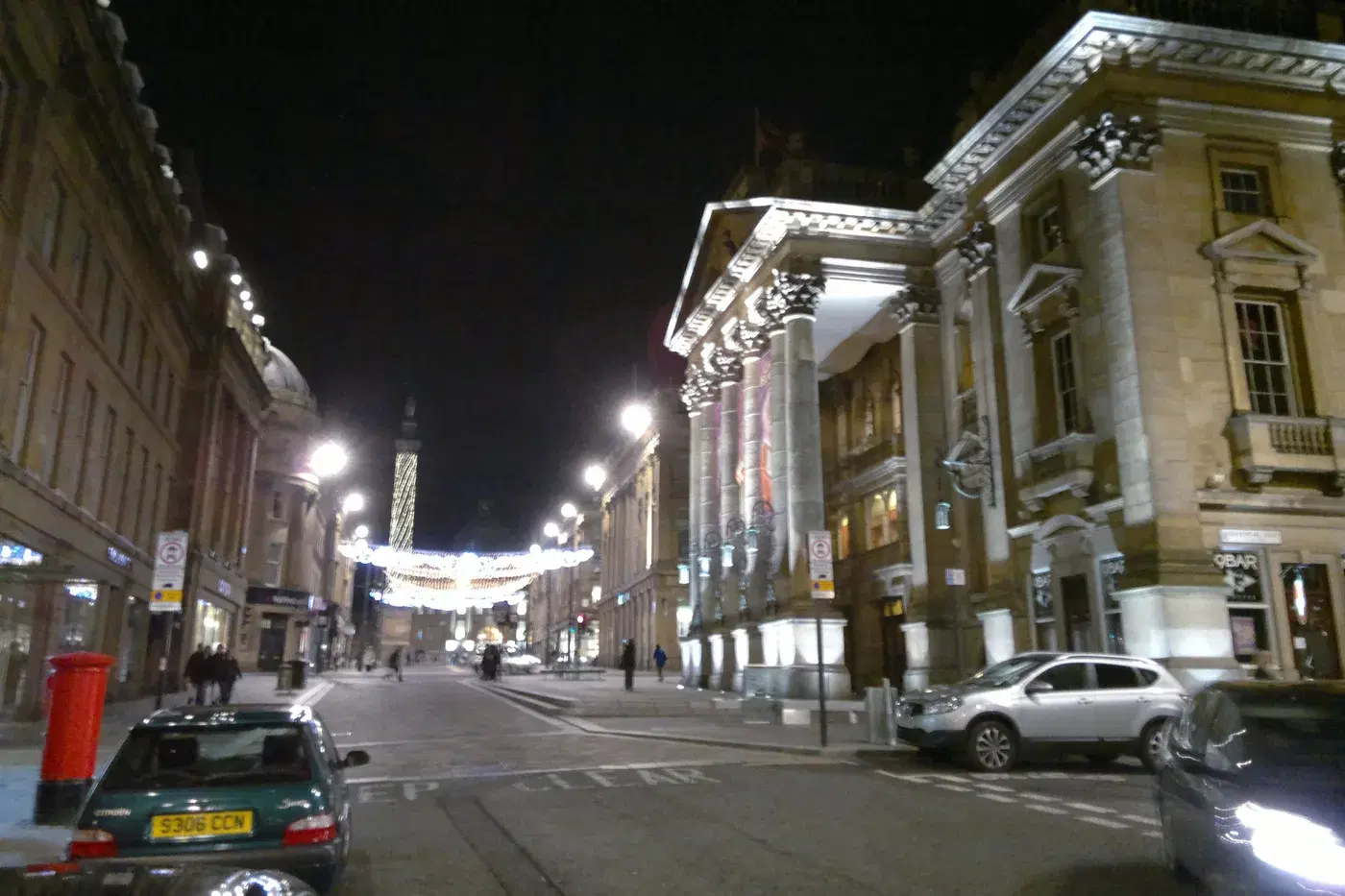
Now walk down Grey Street. The curve is the point. Rather than driving a straight line through the old Lort Burn valley, the designers followed the fall of the land, so the terraces bend away in front of you and the facades reveal themselves one at a time. The classical detailing is consistent without being repetitive, and the whole descent works as a single composition.
Roughly halfway down, the Theatre Royal Newcastle breaks the line with a Corinthian portico that deliberately closes the view up the street. Newcastle's first Theatre Royal stood on Mosley Street from 1788 but was demolished in 1834 to make way for Grainger's redevelopment; the replacement, by the local architects John and Benjamin Green, opened on 20 February 1837 with The Merchant of Venice. A fire after a performance of Macbeth in 1899 gutted the interior, and Frank Matcham rebuilt it in lavish Edwardian style, reopening on 31 December 1901. The building has been Grade I listed since 1954.
A £4.75 million restoration in 2011 returned Matcham's auditorium to its original colour scheme, and it now seats 1,249 across stalls, grand circle, upper circle and gallery. If you can get inside, do: the outside is Georgian restraint and the inside is Edwardian excess, and the contrast tells you a lot about both centuries.
Best for: Worth timing the walk to end in an evening performance; the foyer bars open to ticket holders before curtain up.
A detour to the Tyneside Cinema
Before you carry on downhill, take the short detour east to Pilgrim Street for the Tyneside Cinema, which extends the story into the twentieth century. It opened on 1 February 1937 as the Bijou News-Reel Cinema, designed and built by Dixon Scott, a Newcastle entrepreneur and great-uncle of the film directors Ridley and Tony Scott. Scott had travelled widely and decorated the foyer and first-floor landing with Art Deco work carrying Middle and Far Eastern influences, much of which survives. The building is Grade II listed.
It is the last purpose-built newsreel theatre in the United Kingdom still in full-time operation. A restoration between 2006 and 2008 uncovered original stained glass and mosaic flooring that had been hidden for decades while adding digital projection and further screens, so the original Classic auditorium now sits alongside the Roxy and Electra. The Coffee Rooms and bar occupy the historic upper floors, which makes this the best mid-walk stop on the route.
Best for: The entrance sits between Pilgrim Street and Northumberland Street, under a minute from Monument Metro.
The Laing Art Gallery
A few minutes further on, the Laing Art Gallery stands on New Bridge Street next to the City Library. It opened in 1904, paid for by Alexander Laing, a Scottish-born Newcastle wine and spirit merchant who gave the city a gallery to mark fifty years in business. Cackett and Burns Dick designed it in a Baroque manner with Art Nouveau detail, and it is Grade II listed.
Inside is the most important public art collection in the city, strongest in British painting from the eighteenth century onwards: John Martin's apocalyptic The Destruction of Sodom and Gomorrah, William Holman Hunt's Isabella and the Pot of Basil, Edward Burne-Jones's Laus Veneris, and works by Reynolds, Turner and Ben Nicholson. For a heritage walk, though, the decorative art rooms matter just as much, because they are full of things made here: Newcastle silver, the enamelled and engraved glasses of William Beilby, and Maling pottery from the once vast Tyneside works. Entry to the gallery is free, and there is a café and shop.
Best for: Free entry, indoors, and the obvious place to retreat to if the weather turns.
Down Dean Street to the Crown Posada
Head back to Grey Street and keep going downhill, where it becomes Dean Street and dives under the railway viaduct towards the river. This is the oldest-feeling stretch of the walk, a narrow canyon of a street that follows the buried Lort Burn, and the change in scale after Grey Street is abrupt.
At the bottom, turn up The Side for the Crown Posada, a tall, slender pub at numbers 31 and 33 dating from 1880 and designed by the local architect W L Newcombe. It is Grade II listed, and the listing reflects how little has been stripped out: a pair of Pre-Raphaelite style stained glass windows facing the street, an elaborate plaster ceiling, mirrored panels along one wall and a run of small snug booths behind the door. The room is a single long space barely wide enough for two people to pass at the bar.
It is one of the oldest surviving pubs in the city centre, run by the Newcastle brewer and pub operator Sir John Fitzgerald. There are no televisions and no fruit machines, music comes from a record player, and there is a rotating selection of cask ales alongside the regular range. Conversation carries, which is the entire idea.
Best for: No televisions, no machines, and not much room. Go early if you want one of the snugs.
Newcastle Castle
Climb up to Castle Garth for Newcastle Castle, and the walk arrives at the beginning of the story. The Romans had already fortified this bluff above the Tyne as Pons Aelius in the mid second century. In 1080 Robert Curthose, son of William the Conqueror, raised a timber motte-and-bailey here, the original new castle that gave the city its name.
Henry II replaced it in stone between 1172 and 1177, the work carried out by the master mason Maurice at a recorded cost of £1,144. That great rectangular keep still stands and is both Grade I listed and a scheduled monument. Henry III added the Black Gate, a twin-towered barbican with drawbridges and portcullis, between 1247 and 1250. The castle later served as a prison, was besieged during the Civil War in 1643 and 1644, and by the nineteenth century had been hemmed in and partly cut through by the railway viaduct that still passes beside it.
The two surviving buildings were brought back together and reopened in 2015 as a single attraction. You can climb through the chapel, garrison rooms and great hall of the keep to the roof, which gives one of the best panoramas in the city, over the Tyne bridges, the Quayside and the cathedral. Interpretation, guided tours and evening events cover the Roman, Norman and later chapters.
Best for: Steep spiral stairs and a lot of them, so leave enough energy for the keep roof.
The town walls, and how to finish
Newcastle's medieval town walls enclosed the trading port that grew up around the castle, and although most were pulled down as the town expanded, substantial stretches survive. The best-preserved runs are on the western side of the centre, near Stowell Street and Bath Lane, where the wall and its towers stand in open ground and are easy to walk alongside. Another fragment can be seen from Castle Garth on the way back towards the High Level Bridge.
Ending there puts you within a few minutes of the Quayside in one direction and Central Station in the other, which makes it easy to close the loop. Walked as a single outing, without long stops, the route is comfortably a morning; with the market, the Laing, a pint and the castle keep, it becomes a full and satisfying day.
Spotted something on this route we should add, or know a building worth a stop? Get in touch via our contact page.
Local businesses mentioned
Theatre Royal Newcastle
100 Grey Street, Newcastle upon Tyne, NE1 6BR
Newcastle Castle
The Black Gate, Castle Garth, Newcastle upon Tyne, NE1 1RQ
Laing Art Gallery
Laing Art Gallery, New Bridge Street, Newcastle upon Tyne, NE1 8AG
Tyneside Cinema
10 Pilgrim Street, Newcastle upon Tyne, NE1 6QG
Crown Posada
31 The Side, Newcastle upon Tyne, NE1 3JE
Matthew's Cheese
Arcade Units 23-24, Grainger Market, Newcastle upon Tyne, NE1 5QQ
Never miss what’s on
Join the weekly Newcastlecity.live digest — the best events, news and local tips, straight to your inbox. Free, one email a week.
What's On
John Pope Quintet + Urvashi
7:30 PM · The Cumberland Arms, James Place Street, Ouseburn, Newcastle upon Tyne, NE6 1LD
Mathew Jonson (Live) and Cousin Dan
11:00 PM · Cobalt Studios, 10-16 Boyd Street, Ouseburn, NE2 1AP
Comic Con at Utilita Arena
9:00 AM - 6:00 PM · Utilita Arena, Arena Way, Newcastle, NE4 7NA