Getting Around Newcastle City Centre Without a Car
A Pop card halves the Metro fare, a bank card will not get you through the barrier at all, and full-size bikes are banned from every city centre station. A practical guide to the Metro, the buses, the walk to the Quayside and the way home late.
Newcastle city centre is one of the easier British cities to manage without a car. The centre sits on a compact plateau with four Metro stations inside it, the mainline station is a short walk from the middle rather than stranded on the edge, and almost everything a visitor wants is within a twenty-minute walk of Grey's Monument.
The traps are not about distance. They are about tickets, about times, and about the fact that the river is a long way below the city. This guide covers the things that are genuinely easy to get wrong. If you are driving in after all, our parking guide covers the car parks and the park and ride sites instead.
The Metro is four stations, not one
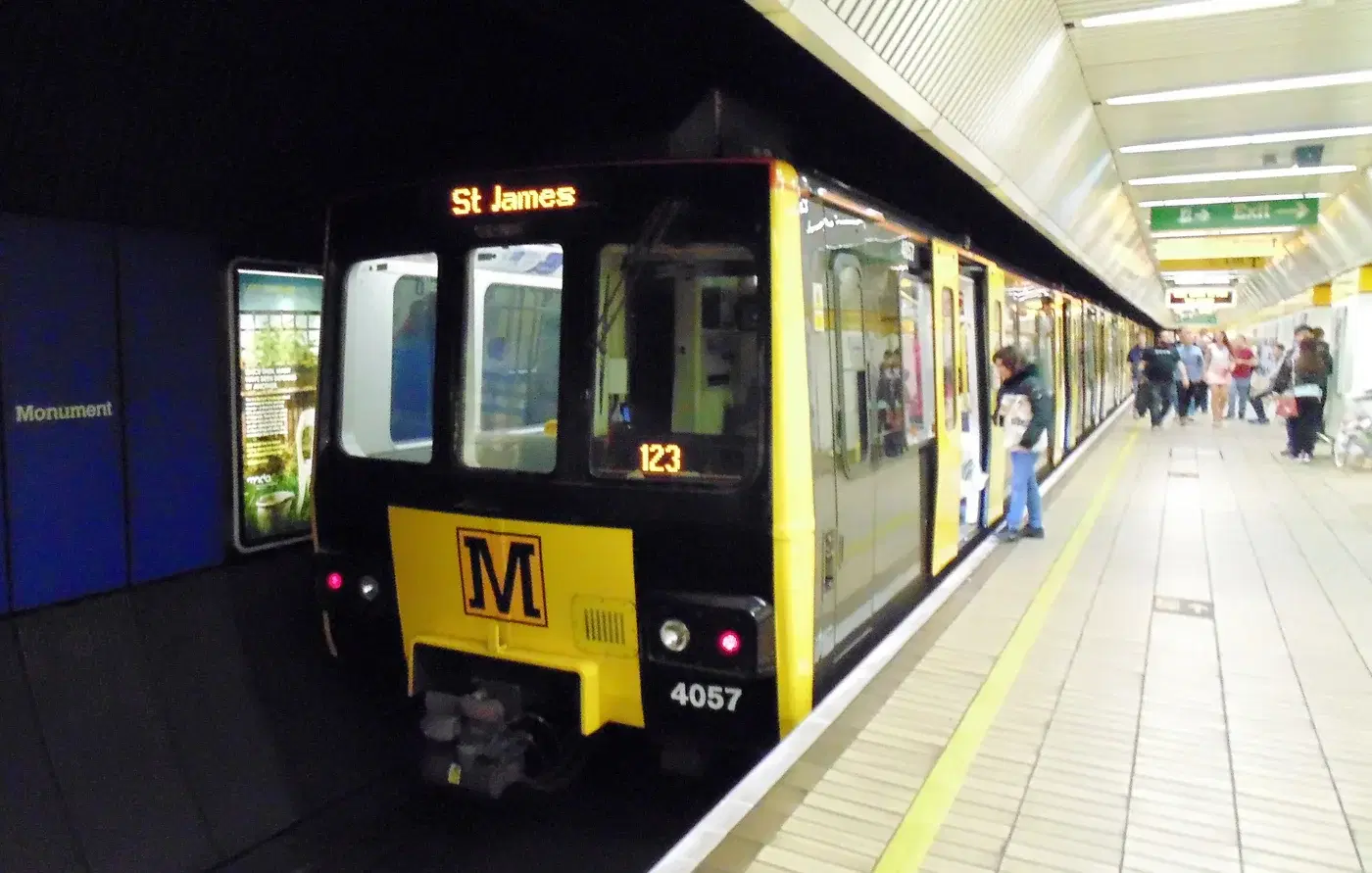
Nexus groups four stations as Newcastle city centre: Central Station, Monument, Haymarket and St James. They are close enough together that the right answer is usually to walk between them rather than pay to ride, and the choice of station matters more for where you come out than for how long the journey takes.
Monument is the middle of the city and the interchange between the two lines. Haymarket is the north end, for Northumberland Street shopping and the two universities. St James is for the stadium. Central Station is for trains, and for the west end of the centre. Manors is a fifth station on the eastern edge, which is the one for the Ouseburn.
First trains from Monument run from about 05.12 on weekdays, but only from about 06.13 on a Sunday. Last trains run until about 00.28 on both. The Sunday start is the fact worth remembering, because it is roughly an hour later than people expect and it catches out early Sunday flights and shifts.
Daytime frequency is every 12 minutes on each line Monday to Saturday, dropping to every 15 minutes in the evening and on Sundays. Between Monument and the south side of the river the lines share track, so the practical frequency through the centre is a train every 6 minutes in the day and every 7 to 8 minutes in the evening. You do not need a timetable for a city-centre hop.
Get a Pop card before you do anything else
This is the single biggest saving available to anyone visiting Newcastle, and it is invisible if you just walk up to a machine.
A paper single from a Metro ticket machine costs £5.10. The same journey on a Pop pay as you go card is capped at £2.50. That is less than half price for doing nothing except carrying the right card. Pop also caps all day Metro travel at £5.00, so two journeys effectively make the rest of the day free.
The card itself is free but is sold with a £5 opening balance, ordered online or bought from a Nexus Travel Shop, and topped up at any Metro ticket machine, online, or in a Travel Shop. There is an Android Pop app for pay as you go Metro travel.
Two things to know about the caps. The daily cap applies to Metro only, not to bus journeys made on the same Pop card. And there is no weekly cap at all: weekly and monthly travel is sold as a season ticket instead, so if you are here for a week, price a season ticket rather than assuming the cap will look after you.
Children travel free, up to three aged 11 and under, on both the Metro and the Shields Ferry.
Best for: Any visit longer than one journey. Order a Pop card before you arrive and the £5.10 paper single stops being your problem.
You cannot tap in with a bank card
As of autumn 2026, the Tyne and Wear Metro does not accept contactless bank cards or phones at the gateline. This is the most common wrong assumption made about the system, because almost every comparable network now does.
The equipment is installed and being accredited, and Nexus is aiming to finish the work by the end of 2026, so this is a fact with a short life. But today, turning up with only a phone means buying a paper ticket at the machine at £5.10, which is exactly the outcome the Pop card exists to avoid.
Buses, and the one ticket trap worth knowing
Bus singles are capped at £2.50 for adults and £1.00 for anyone aged 21 or under under the Mayor's Fares scheme, with children free. A regionwide day ticket covering bus, Metro and ferry across the whole North East is £7.50, or £3.00 for under-21s. If you are moving around the region for a day, that one ticket is almost always the answer.
Go North East sells a Newcastle and North Tyne day ticket at £5.90, which is the cheaper option if you are staying inside the city and the coast. There is no city-centre-only day ticket.
The trap is at the other end of the scale. Go North East's Gateshead Borough day ticket is explicitly not valid for travel to or from Newcastle city centre, which is a genuinely surprising restriction given the two town centres are a ten-minute walk apart across the river. Buy the wrong one because it is cheaper and you cannot use it for the journey you bought it for.
Two other things worth knowing. The old Tyne and Wear Day Rover was withdrawn in April 2026, so any guidance mentioning it is out of date. And PlusBus, which you can add to a train ticket for unlimited bus travel around Newcastle, is not valid on the Metro — a reasonable thing to assume and wrong.
The caps are currently confirmed only to spring 2027, so check before relying on them much beyond that.
The main city-centre bus interchanges are Eldon Square Bus Station on Percy Street, which reopened at the end of June 2026 after resurfacing and drainage works, and Haymarket Bus Station next to Haymarket Metro. Both are in normal use. Beyond those, buses pick up at street clusters around Market Street, Pilgrim Street, John Dobson Street, Grey Street and the Quayside rather than from a single terminus.
The Q3 is the step-free way down to the Quayside
If you cannot manage the hill, or you have a pushchair or a wheelchair, this is the route. The Q3, run by Go North East and branded Voltra, links Haymarket and Monument directly to Quayside Guildhall and Quayside Law Courts, bypassing the Dean Street and Side gradient entirely. The buses are low-floor with ramp access, wide gangways, dedicated wheelchair and buggy bays and audio-visual stop announcements.
Three practical details. The stop is not in the same place in both directions: heading down to the river you board on Market Street or Grey Street, and coming back up you board on Pilgrim Street. It runs every 20 minutes on weekdays and every 30 minutes on Sundays. And on Sundays the first Quayside-bound Q3 is not until about 08.24, which is a real gap if it is your only step-free option for a Sunday morning.
You will still see this service called Quaylink on tourist and community websites. That branding ended five years ago. The route is the Q3.
From Central Station rather than Monument, the Quayside bus is the 53 instead, which the Q3 does not serve.
Best for: Getting down to the Quayside and back without the hill. The Q3 from Market Street, returning from Pilgrim Street.
Walking: the plateau and the river are not the same height
The city centre sits on a plateau and the Quayside sits on the river, and the gap between them is the one piece of Newcastle geography that surprises people on foot. Grey Street and Dean Street are the main routes down.
Allow 9 to 10 minutes from Monument down to the Quayside, and 13 to 16 minutes back up. That asymmetry is the honest way to describe the climb, and it is worth planning a route that only does it once. Walking east along the river into the Ouseburn and coming back up by Metro from Manors or Byker is a more comfortable afternoon than doing the hill twice.
Other walks worth knowing, all from published sources rather than estimates:
| Route | Time |
|---|---|
| Central Station to St James' Park | 10 minutes |
| Monument to St James' Park | 5 minutes |
| Monument to the Northumbria University campus | 7 minutes |
| Haymarket Metro to the Northumbria campus | 3 to 5 minutes |
| Central Station to the top of Stepney Bank, Ouseburn | 20 minutes |
| Byker or Manors Metro to the middle of the Ouseburn | about 15 minutes |
Pedestrian signage runs throughout the centre, and it is generally reliable.
Step-free travel, and the 11.15pm problem
All four city-centre Metro stations are step-free, but they achieve it in different ways, and that difference matters:
- Monument is step-free by lift, from the Eldon Square precinct entrance only. The Blackett Street and Grey Street entrances have steps. Nexus's own guidance notes a long ramp down from the stairs and lift to the concourse, and warns the incline may be difficult for some people.
- Haymarket and St James are step-free by level access, with no lift. Platforms connect via the concourse.
- Central Station is step-free by lift from the mainline station down to the Metro concourse.
That last one carries the catch. The doorways between the mainline station and the Metro are closed by the railway station each evening at about 11.15pm. After that, the only ways in are the Neville Street and Grainger Street entrances, which are stairs. So the step-free interchange between train and Metro at Central Station disappears for the last hour or so of service. If that is your route home, travel before it or plan the Q3 or a taxi instead.
Trains have sliding steps that close the platform gap and four wheelchair bays each. Assistance can be booked four hours ahead on 0191 203 3666. Nexus also issues a Bridge Card, which quietly signals to staff that you may need extra help, with no registration and no fare implication.
The mainline station itself is rated as having some step-free access to all platforms rather than full step-free access, so if you are connecting onto a train, check your specific platform rather than assuming.
One correction worth making, because it is widely repeated: it is not true that every Metro station has lifts. Haymarket and St James do not have one.
Getting to the airport, including before the Metro starts
The Metro runs to Newcastle Airport from all four city-centre stations, and for most flights it is simply the right answer.
It does not, though, get you there for the first departures of the day. The first airport-bound train from Monument is at about 05.54, which is too late for a 6am or 7am flight. The answer is the 787 night bus, which calls at Monument at around 03.08, 04.08 and 05.08, seven days a week. Several airport travel pages miss this, so it is worth knowing it exists.
Getting home late
The Metro runs until about half past midnight, which covers most evenings out but not a full night.
After that, buses are thin and geographically specific. There is no night bus to the coast — no Metro, and nothing serving Whitley Bay or Tynemouth through the night. The two night services that do run are the Angel N21 on Friday and Saturday nights, and the Cityrider 56. If you are heading to the coast after midnight, a taxi is the plan, and it is worth agreeing that before the evening starts rather than at 1am on the Bigg Market.
Taxis
Newcastle has both hackney carriages you can flag or pick up at a rank, and private hire you must book.
The ranks that can be confirmed are outside Central Station, outside Monument Metro and outside Haymarket Metro. There are others, and you will find lists online, but the council's own published rank list has not been updated since 2019 and is no longer online, so treat any list you find with caution. The reliable rule is to read the sign at the bay: where no hours are shown, the bay operates 24 hours a day, seven days a week.
City-centre ranks are marshalled at busy times on weekend nights, and a Safe Haven van operates in the city centre on Friday and Saturday nights, usually in the Bigg Market area, roughly 10pm to 4am. It is a place to go for help if a night out has gone wrong.
One caveat on both: these schemes are funded by the city's Late Night Levy, and that funding arrangement is changing from November 2026. The schemes may well continue under a different arrangement, but do not assume the detail here survives the winter unchanged.
Cycling: the city centre is the one place you cannot take a full-size bike
This is the most counter-intuitive rule in Newcastle transport, and the easiest to fall foul of.
Nexus allows non-folding bikes on the Metro outside peak hours and all weekend, which sounds generous. But the permitted sections exclude the middle of the city: bikes are not allowed at St James, at the Airport, or anywhere between Haymarket and Gateshead station. That takes out Haymarket, Monument and Central Station, at every time of day, including weekends. The nearest stations where you can take a full-size bike are Jesmond and Manors.
Folding bikes, including folding e-bikes, are allowed at any time, fully folded, with protruding handlebars and pedals bagged. For the city centre they are the only option. There is no charge for carrying a bike, and the designated space gives priority to wheelchair users and pushchairs.
Electric scooters and electric unicycles are banned outright from Metro stations, trains and the Shields Ferry. Non-powered folding push scooters are fine.
For riding, the useful pieces of infrastructure are the segregated two-way cycleway on John Dobson Street, which is the main north to south route through the centre, the protected two-way track on Queen Victoria Road past the RVI, and the flat traffic-free riverside paths along both banks of the Tyne, which take you east towards Tynemouth and west towards Hexham. East to west across the centre itself is weaker: Blackett Street is the through route but it is a bus street shared with cyclists, not protected.
For parking, there are council stands outside Monument on Blackett Street and Grey Street, outside Haymarket at the top of Northumberland Street and on the Percy Street side, and inside the railway station near the Metro entrance at Central Station. The only secure council cycle store in the centre is at the Eldon Garden multi-storey, open 8am to 10pm daily, with a £15 fob deposit collected from Eldon Square with photo ID.
Two final notes. Newcastle has no public cycle hire or e-scooter scheme — the previous e-scooter trial ended in May 2026, and several council pages still describe it as if it were running. You can still rent a bike commercially from The Cycle Hub on the Quayside. And on the Tyne Bridge, restoration works continue into 2028 but one footway is kept open at all times for pedestrians and cyclists, currently the western side. Which side is open changes with the phase of the works, so check before you set out.
Fares, timetables and roadworks all change. Everything here was checked in September 2026, but confirm anything you are depending on. Spotted something out of date? Let us know via our contact page.
Never miss what’s on
Join the weekly Newcastlecity.live digest — the best events, news and local tips, straight to your inbox. Free, one email a week.
What's On
Caitlin Moran: How To Be Hopeful, Northern Stage
7:30 PM · Northern Stage, Barras Bridge, Newcastle, NE1 7RH
The Lynsey Dolan Band at The Tyne Bar
4:00 PM · The Tyne Bar, 1 Maling Street, Ouseburn, Newcastle upon Tyne, NE6 1LP
Juni Habel plus Watersmeet
7:30pm · The Cumberland Arms, Ouseburn, Newcastle