Free Things to Do in Newcastle City Centre
Newcastle has four free museums and galleries, a Grade I listed covered market, two miles of medieval town wall, a thousand acres of common land and a free organ recital every Monday. Here is what genuinely costs nothing, and what used to be free but is not any more.
Newcastle is unusually generous for a day out with no money. The city's four main museums and galleries are free, its Grade I listed market is free to walk into, the best surviving stretch of its medieval wall is an open-air public path, and there is a free organ recital in the cathedral every Monday lunchtime. Almost everything below is within twenty minutes' walk of Grey's Monument.
There is also a lot of out-of-date information about free Newcastle circulating online. Several things widely described as free either charge now or have closed entirely, and at least one thing that used to be ticketed has quietly become free. The last section of this guide deals with those, because knowing what has changed saves a wasted journey.
Great North Museum: Hancock
The Great North Museum: Hancock on Barras Bridge is free and it is the strongest free venue in the city for children. It is the merged successor to the Natural History Society of Northumbria's Hancock Museum of 1884, reopened in 2009 after a redevelopment that brought Newcastle University's archaeological and Greek collections under the same roof. The Hadrian's Wall gallery holds altars and inscriptions lifted from the Wall along with a large-scale model of its entire length, the Shefton collection covers Greek and Etruscan material, and there is a life-size T-Rex cast and a large natural history hall.
Budget an hour and a half to two and a half hours. One thing to know: the Planetarium is ticketed separately, from £2.95 a person, bought at the museum shop, so it is not part of the free visit. The museum flags its own quieter times as weekday afternoons after 2.30pm and Sundays, and it runs relaxed early openings on Tuesdays from 9am in school holidays. Haymarket Metro is directly outside.
Best for: The best free two hours in Newcastle with children, and the Planetarium is the only paid part.
Laing Art Gallery
The Laing on New Bridge Street is Newcastle's principal art collection and free to enter, with donations welcome. Alexander Laing, a Scottish-born wine and spirit merchant, gave the gallery to the city, and it opened in 1904 in a Baroque building by the Newcastle practice Cackett & Burns Dick. The collection is strongest in 18th and 19th century British art, with major John Martin canvases, Pre-Raphaelite work and a good deal of Newcastle-related painting.
Two current caveats matter. The Laing is now closed on Sundays and bank holidays, which contradicts a large number of older listings, and there is an admission charge for its Pre-Raphaelites: Art and Poetry exhibition, so free entry covers the rest of the gallery but not that. Allow 45 to 90 minutes. It sits next door to the City Library, three minutes from Monument.
Best for: Free, but closed on Sundays now, and the Pre-Raphaelites show is ticketed.
Discovery Museum
The Discovery Museum at Blandford Square is free and holds the city's science, technology and social history collections in Blandford House, the old Co-operative Wholesale Society regional headquarters. The centrepiece is Turbinia, Charles Parsons' steam-turbine vessel, which was the fastest ship in the world when it was built and famously gate-crashed the 1897 Spithead naval review. It fills a purpose-built hall on the ground floor.
This is the other genuinely strong free option with children, because the science galleries are hands-on rather than behind glass. Allow two to three hours. Note that it closes on bank holidays, and that weekend opening starts an hour later than weekdays. It is about eight minutes' walk from Central Station, which makes it an easy pairing with the Life Science Centre if you were going to pay for something anyway.
Best for: Free, hands-on and built around the fastest ship in the world.
Hatton Gallery
The Hatton is Newcastle University's public gallery, off King's Road behind the Great North Museum, and it is free with donations welcome. It is the smallest and most focused of the four, running a changing exhibition programme rather than a large permanent display, so it is a 30 to 45 minute visit and better suited to adults and older children than to small ones.
Its single most important holding is the Merzbarn wall by the German Dada artist Kurt Schwitters, the wall relief he made in a barn at Elterwater in Cumbria at the end of his life, which was cut out of the building and brought to Newcastle. Because the gallery rotates its displays, check the current exhibition listing before travelling if the Schwitters is specifically why you are going. It closes on Sundays.
Best for: Free, and worth the detour for the Schwitters, but check it is on display.
Newcastle Cathedral
Newcastle Cathedral on St Nicholas Square is free to enter, with donations invited. The church began in the early 12th century, soon after the castle, and was substantially extended in the 14th. Its defining feature is the 15th-century lantern tower, a crown spire carried on flying buttresses which worked as a navigation light for ships coming up the Tyne and still dominates the skyline seen from the bridges.
Inside it holds one of the largest collections of monuments and ledger stones of any English cathedral, medieval heraldic bosses, regimental colours, and the medieval-style screens and choir stalls carved by Ralph Hedley shortly before this became England's most northerly cathedral in 1882. The organ's central case goes back to a Renatus Harris instrument of 1676, played by Charles Avison across his 34 years as Newcastle's organist. Allow 30 to 45 minutes, there is a refectory cafe, and it is fully wheelchair accessible. Hours vary with services, so check before a special trip.
Best for: Free, central, and the best single piece of medieval Newcastle still standing.
The medieval town walls
The best surviving run of Newcastle's town wall is the West Walls stretch behind Stowell Street and Chinatown. It is open air, unrestricted and free at any hour. A second good stretch stands at Orchard Street near Central Station, and a further fragment survives in St Andrew's churchyard on Newgate Street, which makes that church a two-for-one stop.
Building began in the 13th century, funded by a special tax called murage granted from 1265 and paid by the town's burgesses, to defend against Scottish raids. The circuit ran for over two miles, was never less than about seven feet thick and stood up to about twenty-five feet high, with six main gates and nineteen towers. Much of it was demolished in the 19th century to open the town up, and remnants of seven towers survive. The curtain containing the Ever, Morden and Heber towers is a scheduled monument. The towers themselves are not open to drop-in visitors, so this is exterior viewing: allow half an hour for the West Walls walk.
Best for: Free, always open, and the most underrated twenty minutes in the city.
Castle Garth, and what the castle charges for
This one needs care, because it is half free. The Castle Garth itself, the Castle Stairs down to the Quayside and the churchyard area are free open-air public space, and they give one of the best free views of the High Level Bridge anywhere in the city. The Castle Keep and Black Gate interiors are a paid attraction, operated as Newcastle Castle, with a ticket valid for a year.
The stone keep was built in 1172 by Maurice the Engineer for Henry II, replacing the earthwork "new castle" raised in 1080 by Robert Curthose, William the Conqueror's son, which is where the city's name comes from. The Black Gate was added in 1247 on the orders of Henry III as a barbican, converted into a house in 1618, and permanently cut off from the keep by the Victorian railway viaduct that now runs between the two. Fifteen to twenty minutes for the free outdoor part. The Castle Stairs are steep, so not ideal with a pushchair.
Best for: The Garth, the stairs and the view are free; going inside the keep is not.
Grainger Market and Central Arcade
The Grainger Market is free to walk into and it is one of the best free hours in the city, particularly in the rain. It was completed on 24 October 1835 to a design attributed to John Dobson, part of Richard Grainger's rebuilding of the town centre, and it is Grade I listed while still being a working covered market rather than a heritage exhibit. In Alley 3 stands the world's oldest surviving Marks & Spencer, the Original Penny Bazaar, trading on the site since 1895 and the chain's smallest branch, with its dark red and gold shopfront intact. The market closes at 5.30pm and on Sundays.
Two minutes away, Central Arcade is free to walk through and takes five. It was built in 1906 by Oswald and Son inside the gutted shell of Grainger's Central Exchange after a fire destroyed the earlier interior in 1901, and it is Grade II* listed. The walls and upper elevations are clad in dark brown and gold faience by Burmantofts of Leeds. Go for the surfaces, not the shops: the arcade's best-known occupant, the music shop J. G. Windows, closed in November 2024 after 116 years, and a great many guides still send people in to browse it.
Best for: Free, indoors, and two of the finest Grade I and Grade II* interiors in the North East.
The Lit & Phil
The Literary & Philosophical Society on Westgate Road was founded in 1793 and is now the largest independent library outside London, with more than 150,000 volumes in a galleried Victorian reading room. The point most visitors miss is that anyone can walk in and use the collections free of charge. Membership is only needed to borrow, so in practice this is a free public room in the middle of the city, and an extraordinarily quiet one.
The building is the attraction as much as the holdings: high bookcases, ladders, busts, long reading desks and a hush that is genuinely rare in a city centre. It is a working silent library, which makes it poor with young children and excellent on your own or with teenagers. Twenty to forty minutes, or considerably longer if you sit down with something. It is a couple of minutes from Central Station, next door to Neville Hall.
Best for: Free to walk in and read, and the best quiet room in Newcastle.
Blackfriars cloister garden
The cloister garden and courtyard at Blackfriars on Friars Street are free to walk into, and you can see the grassy outline of the demolished friary church without eating there. The restaurant in the old refectory and the craft workshops in the surrounding ranges are commercial, but the enclosed green square in the middle is public.
The friary was founded in 1239 by Sir Peter Scott, the first Mayor of Newcastle, and grew to cover about seven acres, arranged round a cloister roughly ninety feet square, which made it one of the largest in the country. It is Grade I listed and the only surviving medieval friary in Newcastle. Fifteen minutes, and it is a safely enclosed courtyard with small children. The town wall runs directly behind it, so the two combine naturally.
Best for: A free, enclosed medieval courtyard a minute off Newgate Street.
Leazes Park and the Town Moor
Leazes Park is Newcastle's oldest purpose-built park and it exists because people asked for it: in September 1857 around 3,000 working men petitioned the council for access to open ground for health and recreation. The park that followed was laid out by the town surveyor John Fulton around a lake above the course of the Lort Burn and opened on 23 December 1873, the first public park on Tyneside. It covers about 17.5 hectares, is Grade II registered, and was restored after a £3.7m Heritage Lottery Fund grant awarded in 2001. For families it is the pick of the free green space: a large woodland play area in two age zones, tennis and basketball courts, table tennis, picnic and barbecue areas, and paths that take a pram. St James' Park looms over the west side.
Walk north through Exhibition Park, on the corner of the Town Moor designated under the Town Moor Improvement Act of 1870 and once known as Bull Park, and you reach the Moor itself: around a thousand acres of common land, more than twice the size of Hyde Park, open to the public and free at all times. The Freemen of Newcastle hold grazing rights here going back roughly a thousand years, capped at no more than 800 cattle, and the Town Moor Act 1988 enshrined the right of the people of Newcastle to take air and exercise on it. You can genuinely walk into a herd of cows ten minutes from Northumberland Street. There are no facilities, so treat it as open grazing land and mind the livestock.
Best for: Free, and the only city centre in England where the walk ends in a field of cattle.
The Quayside and the bridges
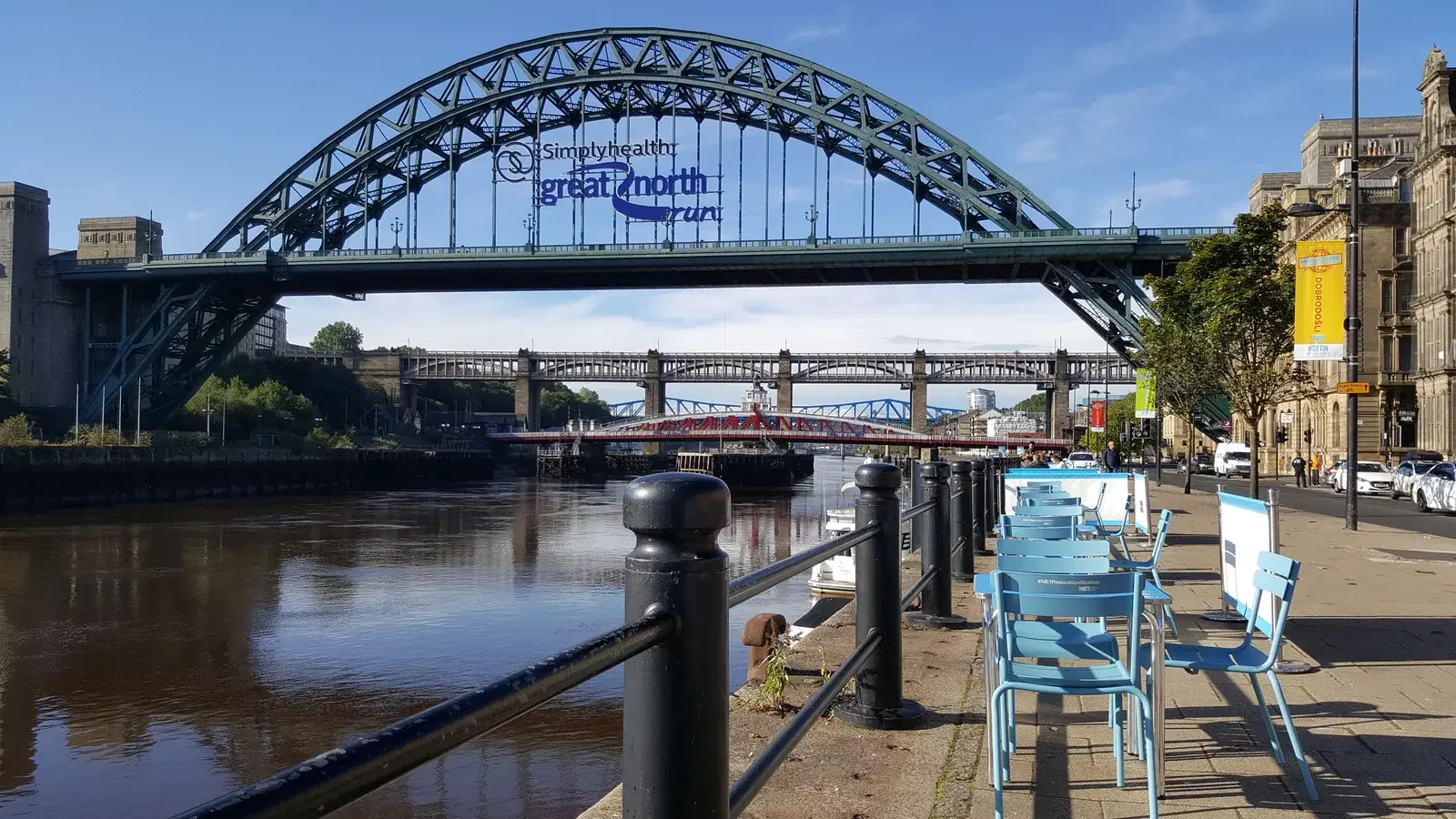
The whole riverside walk is free, as is every pedestrian crossing on it, and a Millennium Bridge, Quayside and High Level Bridge circuit is about an hour to an hour and a half. It is the best free family walk in the city.
The Gateshead Millennium Bridge opened in 2001, designed by WilkinsonEyre with engineers Gifford, and it is the Tyne's only foot and cycle bridge. It tilts at noon on Fridays, Saturdays, Sundays and Mondays from 1 May to 30 September, and on demand for shipping at any time of year, all free to watch. Outside that summer window there is no scheduled tilt, so do check the current schedule before promising anyone a show.
The High Level Bridge is the one to prioritise. Designed by Robert Stephenson and opened by Queen Victoria on 28 September 1849, it was the world's first double-deck road and rail bridge, it is Grade I listed, and it reopened as normal for pedestrians after a £5.2m Network Rail repainting and strengthening programme. Walkways run along both sides of the lower deck, barrier-separated from the buses and taxis. It is the best free high-level Tyne viewpoint in Newcastle and the signed alternative crossing while the Tyne Bridge is being restored, where only one footway is open at a time, scaffolding reaches the deck in autumn 2026, and work on the main arch runs through 2027 to completion for the bridge's centenary in 2028.
Also here: the Swing Bridge, designed and paid for by William Armstrong and opened to road traffic on 15 June 1876, the world's first hydraulically powered moving bridge, still running on Armstrong's original engines. It is worth looking at, but it has not been able to swing since 2019, so do not plan a visit around seeing it move. Bessie Surtees House on Sandhill is a minute away, and its Jacobean timber frontage is free to admire from the street whether or not the interior is open.
Best for: Free, and the High Level Bridge is a better walk and a better view than the Tyne Bridge.
Free things that happen on a schedule
Four regular free events are worth planning around.
| What | When | Where |
|---|---|---|
| Cathedral organ recital | Mondays, 1.05pm, no booking | Newcastle Cathedral nave, NE1 1PF |
| Quayside Sunday Market | Sundays, roughly 9am to 4pm | Quayside, Swing Bridge to Millennium Bridge |
| LIVE in the King's Hall concerts | Thursdays, 1.15pm, term time, first come first served | Armstrong Building, Newcastle University, NE1 7RU |
| INSIGHTS Public Lectures | Term time, free but pre-booking required | Curtis Auditorium, Herschel Building, NE1 7RY |
The cathedral recitals run year-round and last 30 to 40 minutes, featuring both cathedral and guest organists on an instrument whose central case goes back to 1676. Donations go to a retiring collection. The King's Hall concerts are free and open to everyone with no ticket, about 45 minutes, and every dated example we could confirm falls inside the university term, so check the current run. INSIGHTS bookings open at 10am one week before each lecture and are paperless, with your name on the door list.
The Quayside Sunday Market is free to browse and sits directly on the bridges walk, which makes it the easy way to combine the two. The council's own page for it does not publish times, and 9am to 4pm is what is widely reported rather than officially stated, so treat it as approximate.
Best for: A Monday recital, a Thursday concert and a Sunday market, all free, all reliable.
Free public art and monuments
All of these are outdoors, in the public realm, and free to see at any hour. On the Quayside there are five in a short walk: the Swirle Pavilion by Raf Fulcher of 1996, a stone, metal and concrete folly whose inner rim carries the names of ports the artist took from a faded shipping sign at Plummer Chare; André Wallace's Siren of 1995 at Sandyford Steps and its companion River God of 1996 at Sandgate, both bronze torsos on tall steel columns; Andrew Burton's Rudder of 1996 in Keelman Square; and the Blacksmith's Needle at St Ann's Wharf, a forged iron column of six segments representing the five senses plus a sixth, hung with mermaids, bells and shells made at public forge-ins.
In the centre, Grey's Monument of 1838 is a forty-metre Doric column by the architects John and Benjamin Green carrying Edward Hodges Baily's statue of the 2nd Earl Grey, and it is Grade I listed. On the north pavement of Blackett Street, Parsons' Polygon by David Hamilton, made between 1982 and 1985, is a clad terracotta relief that conceals a ventilation shaft for Monument Metro station, its six faces carrying mouldings abstracted from Sir Charles Parsons' own engineering drawings; Historic England listed it Grade II, the first Metro artwork to be protected. Sean Henry's Man with Potential Selves of 2003 stands on Grainger Street. Up at Barras Bridge are William Goscombe John's Response 1914, the Northumberland Fusiliers memorial of 1923 and Grade I listed, and Hamo Thornycroft's William Armstrong statue of 1905 to 1906 outside the Great North Museum.
The Civic Centre, Grade II* listed and opened by King Olav V of Norway in November 1968, carries David Wynne's River God Tyne on its flank, a 4.8 metre bronze with water running from the outstretched hand down the body, which is why the patina has gone green and brown. Wynne also made the Swans in Flight bronzes there, and twelve cast bronze seahorse heads by J. R. M. McCheyne crown the tower. On St Andrew's Street, the Chinese Arch stands eleven metres high with a nine-metre span, opened on 21 February 2005, designed by Yonglai Zhang and built by twelve craftsmen from Changsu in Jiangsu Province. Its seven decorative panels depict scenes and figures from Tyneside rather than from China. It was funded by the city council, One NorthEast and the Lottery, and was not a gift from a twin city.
For a free self-guided route, Discovering Britain, run by the Royal Geographical Society, publishes a two and a half mile circular Newcastle walk called Building Bridges with a free downloadable guide and free audio narration.
Best for: Free, at any hour, and a Quayside sculpture walk takes about forty minutes.
Seasonal free things
Two dated items are worth putting in the diary. The Newcastle Christmas Market runs from Thursday 19 November to Wednesday 23 December 2026, 10am to 8pm Monday to Saturday and 10am to 5pm on Sundays, and it is free to enter and browse. It occupies Grey Street, Grainger Street, the area around Grey's Monument and Nelson Street, extended this year onto Blackett Street and Northumberland Street, with more than seventy traders of whom the large majority are based within twenty miles.
The Late Shows is an after-hours culture crawl held annually in May across sixty-plus venues, entirely free, with central Newcastle running on the Saturday evening. The 2026 edition was on 8 and 9 May; line-ups are usually published in March, and 2027 dates are not yet out. The Hoppings on the Town Moor, billed as Europe's largest travelling funfair, is free to enter with rides priced individually, and recurs in late June. The Great North Run is free to watch from the roadside, and because the start is on the central motorway, city-centre spectating is genuinely worthwhile.
One to note rather than plan for: Holy Jesus Hospital on City Road is in National Trust care but is a working office rather than a drop-in attraction, opening for special events including Heritage Open Days each September. It was founded in 1681 by the Mayor and Burgesses for the relief of Freemen, their widows and unmarried children, on the site of an Austin friary, and it is one of only two complete 17th-century brick buildings surviving in Newcastle.
Best for: The Christmas Market from 19 November is the one still ahead of you this year.
What is no longer free, or no longer there
This is the section that saves wasted journeys, because every item here is still described as free or open somewhere online.
Side Gallery on The Side is permanently closed and will not reopen. It closed in 2023 after losing Arts Council England revenue funding, and in December 2025 it was confirmed that Side will no longer be gallery-based and is not returning to its Quayside space. The AmberSide Archive is moving to Newcastle University Special Collections.
J. G. Windows in Central Arcade has closed. It shut on 29 November 2024 after 116 years, having entered administration. Guides that send you into the arcade to browse the music shop are out of date; go for the faience.
Bessie Surtees House is no longer a free drop-in. English Heritage runs it as free guided tours on selected dates only, booked in advance, with a donation requested. The old "free, weekdays 10 to 4" line is wrong.
Climbing Grey's Monument is not free. It is £7 a person on Newcastle City Guides tours, in half-hour slots between 10am and 3.30pm on a limited number of days a year, pre-booking essential, tickets released at 9am two weeks before each tour. There are 164 steps, under-fives are not admitted, and 5 to 16 year olds must be accompanied and pre-booked. Looking at it from the pavement is of course free.
Newcastle City Guides' City Highlights walking tour is not free either, at £10 for adults with accompanied under-16s free, daily from 1 May to 31 October.
The Life Science Centre at Times Square charges. It gets lumped in with the free museums regularly; it is not one of them.
BALTIC across the Millennium Bridge is free but closed Mondays and Tuesdays, which a lot of listings still miss, and the Laing is closed Sundays. The Great North Museum's Planetarium is ticketed even though the museum is not.
And one correction in the other direction, which is genuinely good news. Seven Stories, the National Centre for Children's Books on Lime Street, is now free entry. Older guides all list it as a paid ticket. It is usually open every day except Wednesdays in term time, though parts are currently closed for renovation, and it is a short walk down from Manors. Our neighbours at heaton.live cover that end of town properly.
Best for: Check the day of the week before you set out: several free venues now close on Sundays or Mondays.
Putting a free day together
A full free day that works: start at the Great North Museum when it opens, walk down through Haymarket to the Laing and the City Library, cut through Central Arcade into the Grainger Market for cheap lunch, then take Dean Street or the Castle Stairs down to the Quayside for the bridges circuit and the sculpture walk, and finish by crossing the High Level Bridge for the view. That is most of a day, all of it free, and about four miles of walking.
For a wet day, the museums, the market, the arcade, the Lit & Phil and the City Library are all indoors and all free, and the walk between them is short. For a free day with small children, the Great North Museum and the Discovery Museum are the two to build around, with Leazes Park's play area as the outdoor half.
Know a free Newcastle thing we have missed, or spotted something here that has changed? Get in touch via our contact page.
Local businesses mentioned
Great North Museum: Hancock
Barras Bridge, Newcastle upon Tyne, NE2 4PT
Laing Art Gallery
Laing Art Gallery, New Bridge Street, Newcastle upon Tyne, NE1 8AG
Discovery Museum
Blandford Square, Newcastle upon Tyne, NE1 4JA
Hatton Gallery
Hatton Gallery, King's Road, Newcastle University, Newcastle upon Tyne, NE1 7RU
Newcastle Cathedral
Cathedral Church of St Nicholas, St Nicholas Square, Newcastle upon Tyne, NE1 1PF
Grainger Market
Grainger Market, Grainger Street, Newcastle upon Tyne, NE1 5QQ
Central Arcade
Central Arcade, Grainger Street, Newcastle upon Tyne, NE1 6EG
Literary & Philosophical Society
23 Westgate Road, Newcastle upon Tyne, NE1 1SE
Newcastle City Library
33 New Bridge Street West, Newcastle upon Tyne, NE1 8AX
Leazes Park
Leazes Park, Newcastle upon Tyne, NE2 4BJ
Bessie Surtees House
41-44 Sandhill, Newcastle upon Tyne, NE1 3JF
Newcastle Castle
The Black Gate, Castle Garth, Newcastle upon Tyne, NE1 1RQ
Blackfriars Restaurant
Friars Street, Newcastle upon Tyne, NE1 4XN
Seven Stories, The National Centre for Children's Books
30 Lime Street, Ouseburn, Newcastle upon Tyne, NE1 2PQ
Never miss what’s on
Join the weekly Newcastlecity.live digest — the best events, news and local tips, straight to your inbox. Free, one email a week.
What's On
Caitlin Moran: How To Be Hopeful, Northern Stage
7:30 PM · Northern Stage, Barras Bridge, Newcastle, NE1 7RH
The Lynsey Dolan Band at The Tyne Bar
4:00 PM · The Tyne Bar, 1 Maling Street, Ouseburn, Newcastle upon Tyne, NE6 1LP
Juni Habel plus Watersmeet
7:30pm · The Cumberland Arms, Ouseburn, Newcastle