Family Days Out in Newcastle City Centre
Newcastle city centre packs five proper family attractions into a walkable square mile, from a museum of children's books to a medieval keep, with parks and a riverside walk to pair them with.
Newcastle city centre is small enough to cross on foot in twenty minutes, which is the single best thing about it if you are out for the day with children. A museum of children's books, a hall built around a record-breaking steam turbine ship, a Roman frontier gallery with a planetarium attached, a Victorian art gallery and an eleventh-century castle keep all sit within the same compact grid or a short Metro hop of it. You can pair any of them with a park or a walk along the Tyne and still be home before the crowds build. Here is how to put a day together.
Seven Stories, The National Centre for Children's Books
Seven Stories, The National Centre for Children's Books is the only museum in Britain devoted entirely to writing and illustrating for children, and it is the most obviously child-shaped day out in the city. It occupies a tall Victorian mill and warehouse at 30 Lime Street in the Ouseburn Valley, the old industrial quarter just east of the centre that has become Newcastle's studio and music district. The conversion kept the building's stacked floors and exposed structure, and the name comes from its seven storeys.
The point of the place is that the books come off the page. Exhibitions are built around characters and illustrations children already recognise, with dressing-up, drawing and making spaces set among the displays, and there is a bookshop and a café. Behind the galleries sits a growing archive of original manuscripts and artwork from British authors and illustrators, which is what the changing exhibitions are drawn from. Storytimes, workshops and performances are bookable in advance rather than turning up on the day. Manors and Byker Metro stations are each roughly ten minutes' walk, and there is parking on Lime Street and in the Ouseburn car parks.
Best for: Parts of the building have been undergoing renovation, so check the opening arrangements before you travel.
Discovery Museum
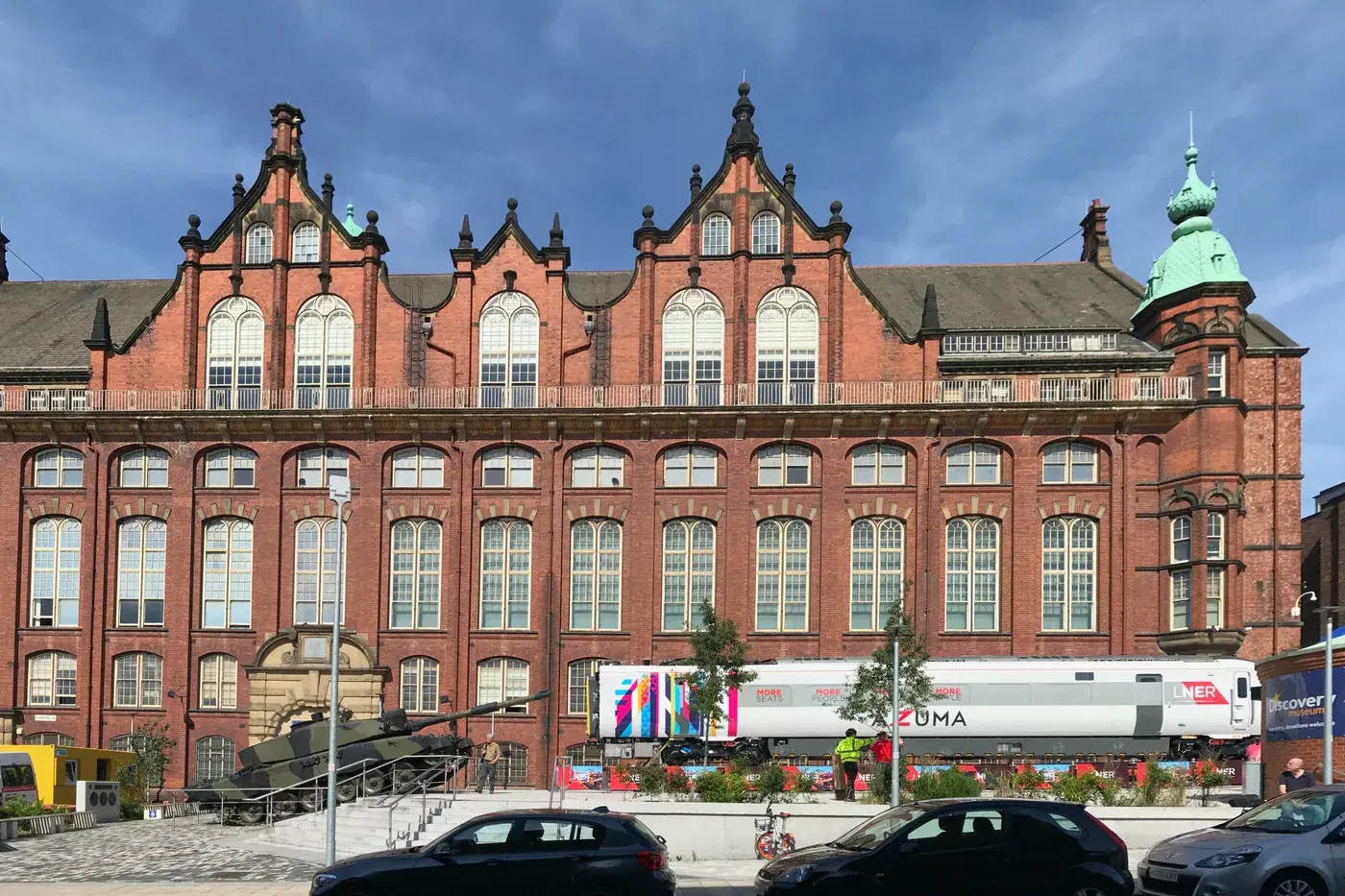
Discovery Museum on Blandford Square is the one to choose if you have children who want to press buttons and look at big machines. It tells the story of Tyneside's inventors, engineers and working life from a confident 1899 building by Oliver, Leeson and Wood, originally the regional headquarters of the Co-operative Wholesale Society and repurposed as a museum in 1978. The collection itself is older, beginning in 1934 as the Municipal Museum of Science and Industry.
The centrepiece is Turbinia, the 31.9 metre vessel Charles Algernon Parsons built to prove the case for steam turbine propulsion, which reached some 34 knots and made a famous uninvited appearance at the 1897 Spithead review. She fills a purpose-built hall on the ground floor and is genuinely startling at close range. Elsewhere there are early incandescent lightbulbs made by Joseph Swan, who demonstrated electric lighting on Tyneside, the Light Dragoons regimental collection covering two centuries of military history, a Tyneside social history gallery and hands-on science displays aimed squarely at children. There is a café on the second floor, a shop at ground level and step-free access throughout, all a short walk from Central Station.
Best for: Step-free throughout and close to Central Station, which makes it the easiest of the five with a pushchair.
Great North Museum: Hancock
Great North Museum: Hancock sits at Barras Bridge on Newcastle University's Haymarket campus, five minutes from Haymarket Metro. It brings together several of the region's oldest collections in one building: the purpose-built Hancock Museum opened on this site in 1884, named after the naturalist brothers John and Albany Hancock, and in 2006 it merged with the university's archaeology, Greek, Egyptian and ethnographic collections. A £26 million rebuilding scheme reopened it under its present name in May 2009 with far more gallery space.
For a family visit it is the most varied of the city centre museums. Permanent displays cover the natural world, Hadrian's Wall and Roman Northumberland, ancient Egypt and Greece, and world cultures, and the large interactive model of the Wall is one of the best introductions to the Roman frontier anywhere in the region. Star objects include Egyptian mummies, a full-size cast of an African elephant and a replica Tyrannosaurus rex skeleton. There is a digital planetarium and hands-on areas for younger visitors. The museum is owned largely by the Natural History Society of Northumbria and managed by North East Museums under agreement with the university.
Best for: Dinosaurs, mummies and a planetarium in one building. Planetarium sessions are worth checking in advance.
Laing Art Gallery
Laing Art Gallery on New Bridge Street holds Newcastle's principal art collection, and it works better with children than a gallery visit might sound. It opened in 1904, paid for by Alexander Laing, a Scottish-born Newcastle wine and spirit merchant marking fifty years in business, in a Grade II listed building designed by Cackett and Burns Dick in a Baroque manner with Art Nouveau detail.
The collection is strongest in British painting from the eighteenth century onwards, and several of the best-known works are the sort that stop a bored ten-year-old dead: John Martin's apocalyptic The Destruction of Sodom and Gomorrah, William Holman Hunt's Isabella and the Pot of Basil, Edward Burne-Jones's Laus Veneris. There are also paintings by Joshua Reynolds, J.M.W. Turner and Ben Nicholson, and a regionally flavoured decorative art holding of Newcastle silver, William Beilby's enamelled and engraved glass, and Maling pottery from the once vast Tyneside works. Temporary exhibitions rotate regularly, so repeat visits are not repeat visits. There is a café and shop on site, Monument Metro is a short walk away, and it sits next to the City Library with the Northumberland Street shops immediately behind.
Best for: The most central of the five, and an easy half hour if a full museum is too much.
Newcastle Castle
Newcastle Castle is the fortress the city is named after, on a bluff above the Tyne at Castle Garth that the Romans had already fortified as Pons Aelius in the mid second century. In 1080 Robert Curthose, son of William the Conqueror, raised a timber motte-and-bailey here, the original New Castle. Henry II replaced it in stone between 1172 and 1177, work carried out by the master mason Maurice at a recorded cost of £1,144. That great rectangular keep, roughly 62 by 56 feet and 81 feet tall, still stands and is both Grade I listed and a scheduled monument. Henry III added the Black Gate, a twin-towered barbican with drawbridges and portcullis, between 1247 and 1250.
The site later served as a prison, was besieged during the Civil War in 1643 and 1644, and by the nineteenth century had been hemmed in and partly cut through by the railway viaduct that still runs beside it. After restoration the two surviving buildings were brought together and reopened in 2015 as a single attraction. Visitors climb through the chapel, garrison rooms and great hall of the keep to the roof, which gives one of the best panoramas in the city over the Tyne bridges, the Quayside and the cathedral. Interpretation, guided tours and evening events cover the Roman, Norman and later chapters.
Best for: Reaching the roof means a climb, so factor in the stairs with very young children.
Leazes Park and Exhibition Park
Two parks bracket the northern side of the city centre and both work well as the second half of a museum day, when everyone needs to be outdoors rather than indoors. Leazes Park lies on the Leazes side of St James' Park, a few minutes from the stadium and walkable from Haymarket or the top of Northumberland Street, which makes it the closest proper green space to the middle of town.
Exhibition Park sits a little further north, close to Haymarket and within easy walking distance of the Great North Museum. It takes its name from the 1929 North East Coast Exhibition, and the art deco Palace of Arts pavilion in the park is the only building from that exhibition still standing. There is a neat link back to Blandford Square here: the collection that became the Discovery Museum was first housed in one of the 1929 exhibition pavilions. Pairing a museum morning with an afternoon in either park is the simplest way to stretch a day out without paying for a second attraction.
Best for: Somewhere to run about after a morning of looking at things, both within walking distance of the museums.
The Quayside and the Gateshead Millennium Bridge
The walk down to the river is a free attraction in its own right, and it starts more or less at the castle. From Castle Garth the streets drop steeply towards the Tyne, past the cathedral and down Side or Dean Street, and open out onto the Quayside beneath the Tyne Bridge. Walking east along the water brings you to the Gateshead Millennium Bridge, the tilting footbridge that takes you across to the Gateshead bank and back again. On the way there are views of the bridges stacked up behind one another, which is the image most people carry away from Newcastle.
Carry on east from the bridge and the riverside path leads towards the mouth of the Ouseburn, which puts you within reach of Seven Stories if you would rather arrive on foot than by Metro. Going the other way, it is an uphill but short walk back into Grainger Town.
Best for: A good option in decent weather, and it costs nothing beyond the ice cream.
Building a full day
The city centre's compactness is what makes this work. A realistic plan is one indoor attraction in the morning, lunch, and either a park or the riverside walk in the afternoon, with the Metro covering the gaps if legs give out. Discovery Museum and the Quayside pair naturally because both sit at the western and southern edges of the centre. The Great North Museum and Exhibition Park are a five-minute walk apart. The Laing and Newcastle Castle can be combined with a stroll through Grainger Town between them.
If you are looking for one more indoor option, the Life Science Centre is also in the city centre, a short walk from Central Station, and is worth adding to your shortlist. Admission arrangements, opening days and bookable sessions vary between all of these venues and change through the year, so check each one's own website before you travel rather than turning up on spec.
Know of another family day out in the city centre we should include? Get in touch via our contact page.
Local businesses mentioned
Seven Stories, The National Centre for Children's Books
30 Lime Street, Ouseburn, Newcastle upon Tyne, NE1 2PQ
Discovery Museum
Blandford Square, Newcastle upon Tyne, NE1 4JA
Great North Museum: Hancock
Barras Bridge, Newcastle upon Tyne, NE2 4PT
Laing Art Gallery
Laing Art Gallery, New Bridge Street, Newcastle upon Tyne, NE1 8AG
Newcastle Castle
The Black Gate, Castle Garth, Newcastle upon Tyne, NE1 1RQ
Never miss what’s on
Join the weekly Newcastlecity.live digest — the best events, news and local tips, straight to your inbox. Free, one email a week.
What's On
John Pope Quintet + Urvashi
7:30 PM · The Cumberland Arms, James Place Street, Ouseburn, Newcastle upon Tyne, NE6 1LD
Mathew Jonson (Live) and Cousin Dan
11:00 PM · Cobalt Studios, 10-16 Boyd Street, Ouseburn, NE2 1AP
Comic Con at Utilita Arena
9:00 AM - 6:00 PM · Utilita Arena, Arena Way, Newcastle, NE4 7NA